
Tokenomics Enterprise DApps
- all
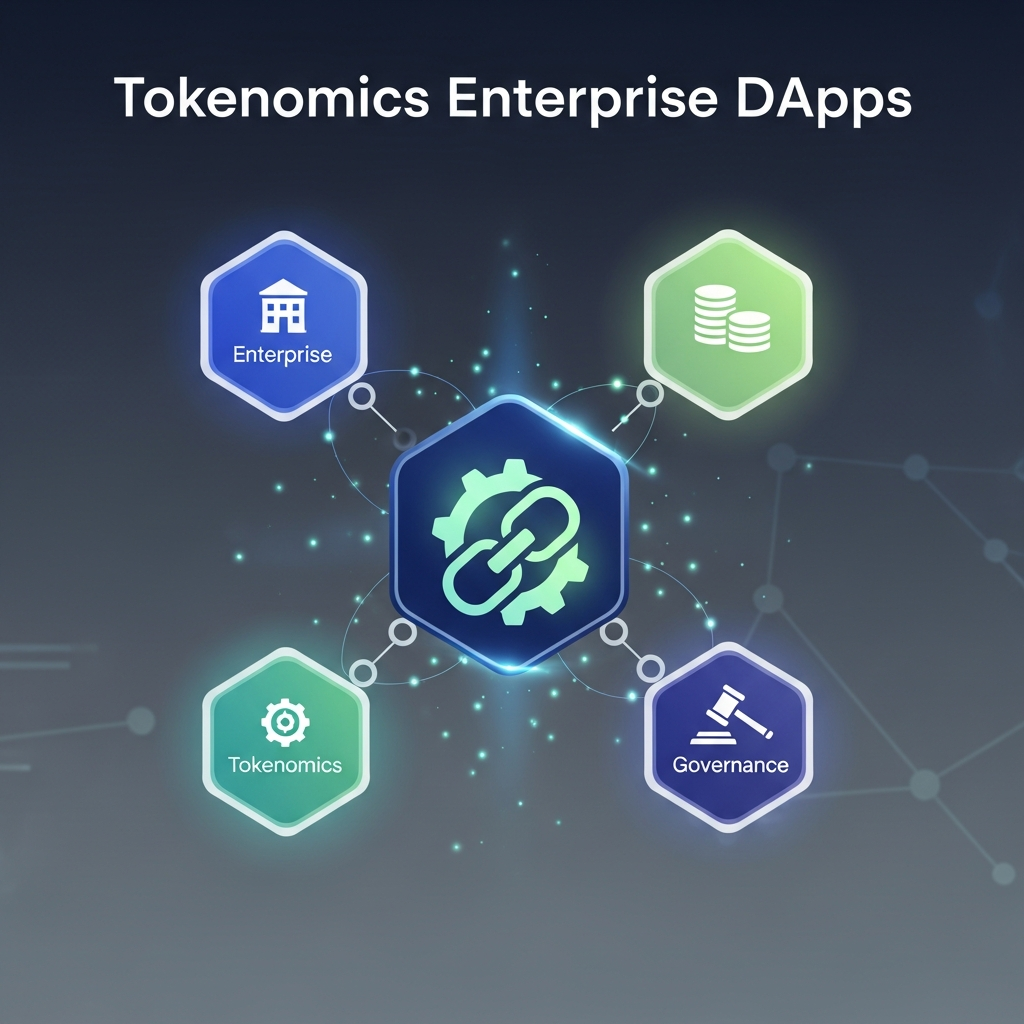
Tokenomics for Enterprise DApps: Designing Sustainable Token Economies, Governance, and Compliance
Introduction
Tokenomics for enterprise DApps is more than a clever incentive scheme. For large organizations, token economics must align with governance, risk, security, and regulatory requirements while enabling scalable operations. Enterprise DApps—whether in supply chains, identity, finance, or compliance-heavy ecosystems—benefit from carefully designed token models that incentivize participation without introducing instability or legal risk. This guide provides a practical framework to design, validate, and operationalize token economies within enterprise settings.
In enterprise contexts, tokenomics touches three domains: value capture (how tokens accrue and distribute value), governance (how decisions are made and who has influence), and compliance (how to stay within the bounds of securities laws, data privacy, and industry-specific regulations). The objective is to create a resilient token economy that supports your DApp goals, such as improving participation, aligning stake with responsibility, and enabling auditable, compliant workflows across organizations and partners.
Token models for enterprise DApps
Choosing the right token model is foundational. Enterprise DApps typically require a disciplined approach to token classification, distribution, and utility. The most common models are utility tokens, governance tokens, and asset-backed or security-like tokens. Each model serves different governance structures and risk profiles, and many projects use a hybrid approach to balance incentives with compliance.
Native utility tokens
A native utility token grants access to services, features, or enhanced performance within the DApp. In an enterprise context, utility tokens can coordinate user behavior, enable resource provisioning, or unlock premium analytics. The key design considerations are scope (which capabilities are unlocked), rate limits, and alignment with service-level objectives. To reduce volatility and misaligned incentives, utility tokens should be tied to real usage metrics, such as throughput, uptime, or task completion rather than speculative trading alone.
Governance tokens
Governance tokens empower holders to influence protocol or platform decisions. For enterprise DApps, governance tokens can formalize participation rights in treasury allocations, feature voting, and protocol upgrades. A common pattern is a two-layer model: a core protocol governed by a trusted council or multi-sig and a broader stakeholder base with voting rights tied to token ownership. To avoid centralized control, consider weighted voting that accounts for expertise, fiduciary responsibilities, and participation history, not just raw token balance.
Asset-backed and security-like tokens
Some enterprise ecosystems require tokens with intrinsic value backed by assets or contractual rights. Asset-backed tokens can represent rights to data access, revenue streams, or collateralized obligations. In regulated environments, security-like tokens may be used to represent equity-like interests or profit-sharing rights. These designs demand rigorous legal analysis and robust compliance controls (privacy protections, KYC/AML, and investor accreditation where applicable). As a result, you’ll often pair asset-backed tokens with strict custody, transfer restrictions, and clear disclosure obligations.
Hybrid models—combining utility, governance, and asset-backed elements—are increasingly common. They enable a single token to serve multiple purposes while enabling modular upgrades to governance or compliance layers as regulations or business needs evolve.
Governance mechanisms for enterprise tokens
Effective governance is the backbone of enterprise tokenomics. It defines how decisions are made, who can participate, and how to reconcile competing interests across a complex network of partners, suppliers, and internal teams. Enterprise governance should emphasize transparency, auditability, and predictability to sustain long-term participation and investor confidence.
On-chain vs off-chain governance
On-chain governance provides verifiable, tamper-evident decision records and automated execution of approved changes. It’s ideal for mission-critical upgrades, treasury disbursements, and policy updates. Off-chain governance, by contrast, supports broader participation and more flexible deliberation through forums, voting sessions, and stakeholder workshops. A practical approach blends both: use on-chain voting for final approvals and off-chain forums for discussion, debate, and consensus-building before submitting proposals to vote.
Voting models and treasury management
Voting models can range from simple token-weighted ballots to reputation-based schemes where participation history and domain expertise influence voting weight. For large ecosystems, consider quadratic voting to dampen influence concentration or staged voting with QA gates to prevent rushed decisions. Treasury management should separate policy issuance, reserve management, and grant disbursement. A transparent treasury policy, publicly auditable transaction logs, and clear milestones reduce ambiguity and foster trust among participants.
Staking, rewards, and alignment
Staking mechanisms align incentives with network health. Enterprise tokens can require stakeholders to stake tokens to participate in governance or earn rewards for long-term engagement and contributions to system reliability. To minimize risk, pair staking with slashing for non-performance or non-compliance and implement disclaimers for reward volatility. Reward structures should be tied to measurable outcomes, such as system uptime, accuracy of data, or adherence to privacy controls.
Compliance frameworks for token economies
Compliance is not optional in regulated industries. Token design must account for security laws, securities classifications, data privacy, and cross-border transfer rules. Establish a formal framework that maps token types to applicable regulations and builds in privacy by design from the start.
Regulatory mapping and classification
Begin with a regulatory mapping exercise to classify tokens by risk and legal status in the relevant jurisdictions. Seek early legal counsel to determine whether a token might be treated as a security, utility, or hybrid instrument. Document criteria for each category and implement governance and disclosure policies accordingly. This mapping informs eligibility criteria, transfer restrictions, and post-issuance reporting requirements.
Privacy, data governance, and access control
Enterprise DApps often handle sensitive data. Token flows should respect data minimization, retention, and access controls. Cryptographic techniques such as zero-knowledge proofs and privacy-preserving smart contracts can help reduce data leakage while maintaining auditability. Implement role-based access, data provenance, and immutable logging to support regulatory audits without exposing private information to unintended participants.
Operationalizing compliance
Compliance is an ongoing discipline. Build in continuous monitoring, periodic security audits, and third-party attestations. Establish a change-management process for policy updates and a clear path for incident response related to token issuance, transfer, or governance events. Document decision trails and maintain separate compliance dashboards for internal teams and external auditors.
Architecture and design patterns
Tokenomics requires robust architecture that can evolve. A thoughtful architecture supports modularity (separate token contracts, governance contracts, and oracle interfaces), security (multi-sig and formal verification), and interoperability (standard token interfaces and cross-chain compatibility). Consider a multi-layer design that isolates token logic from application logic, enabling upgrades without destabilizing existing participation and value flows.
Token distribution and vesting
Plan initial allocations for teams, advisors, partners, and communities with vesting schedules that align with long-term platform health. Include cliff periods, performance milestones, and gradual release curves to prevent large sell-offs that could destabilize the token price or governance balance. Public disclosure of distribution helps build trust with users and regulators alike.
Inflation control and economic stability
Define inflation models that support growth without runaway dilution. Options include fixed-supply with scheduled minting tied to utilization metrics, periodic token burns tied to platform revenue, or income-backed minting where new tokens are minted only when certain service levels are met. Correlate token supply changes with observable platform usage to maintain price stability and user incentives.
Cross-chain interoperability
Enterprise ecosystems often span multiple networks. Design token standards and bridges that minimize risk and latency while preserving governance integrity. Consider modular bridge components and standardized messaging formats to facilitate secure cross-chain token transfers and governance participation across ecosystems.
Security and risk management
Security is foundational for enterprise tokenomics. The combination of smart contracts, treasury logic, and governance interfaces represents a critical attack surface. A formal threat model should cover common vectors such as reentrancy, front-running, access control failures, and oracle manipulation. Regular audits, fuzz testing, and formal verification when appropriate help reduce risk and increase confidence among participants and regulators.
Audits and assurance
Schedule independent security audits with reputable firms and mandate repeatable testing across upgrades. Implement bug bounty programs with clear scopes and triage processes. Maintain a runbook for security incidents, including token revocation procedures and governance emergency pauses if necessary.
Operational controls and governance hygiene
Adopt governance hygiene practices such as phased deployments, time-locked upgrades, and role-based access controls. Maintain separate environments for development, staging, and production with rigorous change-management governance. Regularly review keys, multisig configurations, and treasury access to prevent insider risk and exfiltration.
Implementation steps for enterprise tokenomics
The journey from concept to a live token economy can be broken into stages: discovery, modeling, validation, deployment, and governance maturation. Each stage emphasizes risk assessment, stakeholder alignment, and regulatory readiness.
Discovery and stakeholder alignment
Start with workshops that map business goals to token use cases. Identify who benefits from token flows, who holds token rights, and how governance will operate. Document success metrics tied to real enterprise outcomes, such as process automation gains, reduced friction in supplier networks, or improved data integrity.
Modeling and simulation
Translate business rules into token mechanics. Build mathematical models of inflation, staking rewards, and governance outcomes. Use simulations to explore how different distributions affect participation, resistance to attacks, and long-term platform health. Adjust parameters before any on-chain deployment to reduce risk of disruptive changes later.
Pilot and phased rollout
Launch a controlled pilot with a subset of participants to observe real-world dynamics. Collect usage data, governance proposals, and treasury activity. Use a staged rollout to demonstrate stability and to refine policy rules, reward criteria, and compliance controls before broader deployment.
Governance operations
Establish ongoing governance rituals: proposal windows, voting cycles, and post-implementation reviews. Create dashboards that track participation, proposal passage rates, and treasury movements. Build a clear escalation path for disputes and a rollback mechanism in case of critical failures.
Case for enterprise token strategies (hypothetical)
Consider a multinational manufacturing network deploying an enterprise DApp to coordinate suppliers, logistics, and compliance checks. A native governance token could empower participants to influence logistics policies, approve quality audits, and authorize treasury disbursements for process improvements. A utility token might unlock priority access to data analytics features while providing dynamic pricing for data-sharing services. An asset-backed token could represent a guaranteed rebate program tied to on-time deliveries or quality scores. The combined model aligns incentives across suppliers, regulators, and internal teams, while a well-defined compliance framework ensures that all token-related activities stay auditable and within regulatory boundaries.
Key outcomes from such a design include improved onboarding for new suppliers, faster dispute resolution through transparent voting, and measurable reductions in compliance risk. The integration with existing ERP and CRM systems ensures that token actions reflect real business events, aligning economic incentives with operational performance.
Roadmap and governance playbooks
Develop a practical road map that emphasizes governance maturity, compliance readiness, and scalable token operations. A typical roadmap might include: (1) token model validation and legal scoping, (2) pilot design with a limited community, (3) governance policy formalization, (4) production deployment with phased access, (5) ongoing governance optimization, and (6) periodic third-party audits and regulatory reviews.
Governance playbooks should cover proposal templates, decision rights matrices, performance metrics, and escalation procedures. Create a governance scorecard that tracks engagement levels, policy adherence, and treasury health. By tying governance outcomes to business KPIs—such as time-to-market for procurements, data quality improvements, or supplier diversity metrics—you can demonstrate ROI to executives and auditors alike.
Conclusion
Tokenomics for enterprise DApps is a strategic architecture problem, not a speculative experiment. When designed with clear models, robust governance, and rigorous compliance, token economies can unlock new levels of collaboration, efficiency, and resilience in large organizations. The most successful programs treat token design as an ongoing program—one that evolves with business needs, regulatory environments, and technological advancements. By grounding tokenomics in enterprise-grade governance, security, and transparency, you create ecosystems that scale, endure, and deliver measurable value.
As you embark on designing an enterprise token strategy, start with a disciplined framework that covers token types, governance, compliance, and operational controls. Use simulations to anticipate outcomes, pilot with a representative audience, and build a governance culture that values participation and accountability. The result is a token-enabled DApp that not only performs efficiently but also inspires trust across the broad network of stakeholders that keeps your enterprise ecosystem thriving.