
Self‑Driving Workflows vs Rule‑Based Automation: Decision Guide for Revenue Teams
- all
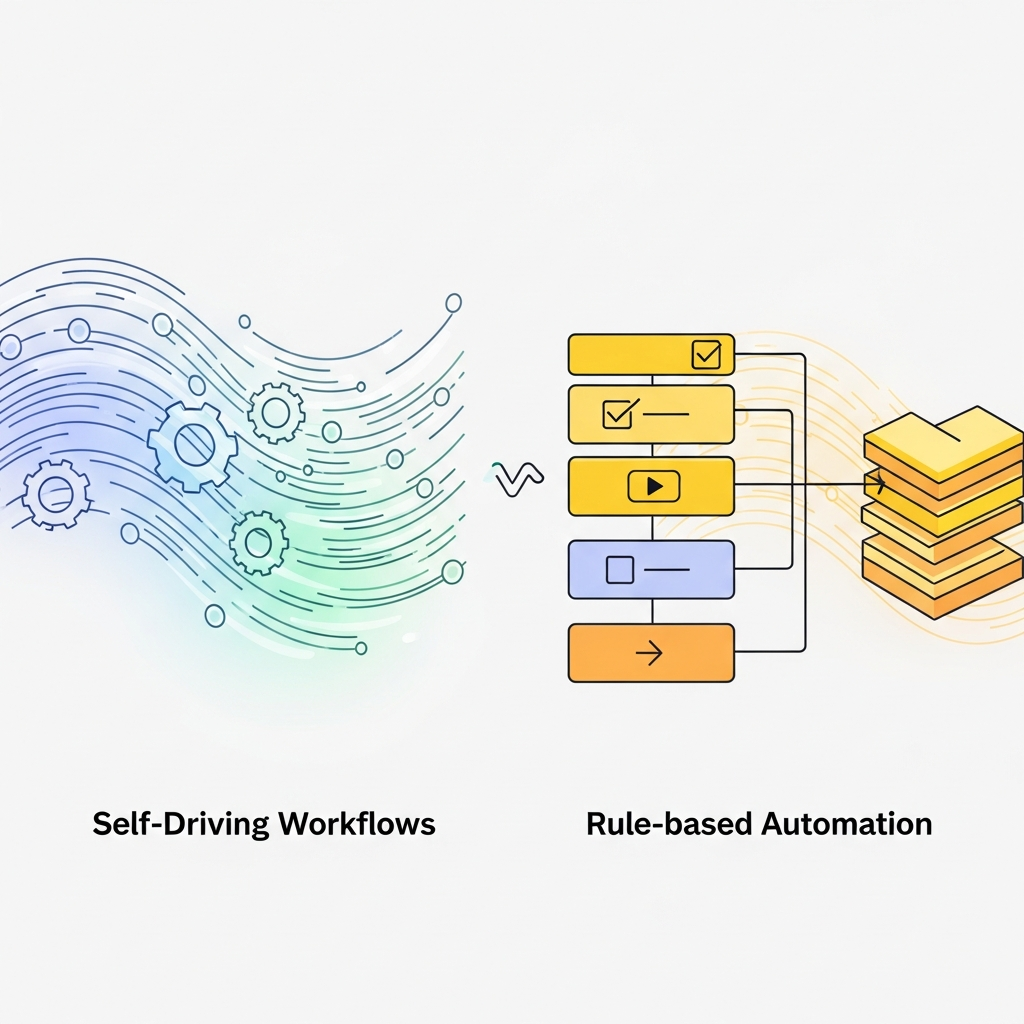
Self-driving workflows vs Rule-Based Automation: Decision Guide for Revenue Teams
Introduction: Why the shift matters
Revenue teams increasingly rely on automation to shorten cycles, improve forecasting accuracy, and accelerate conversion. Traditional rule-based automation has served well for predictable, repeatable tasks, but as customer journeys become more complex, there is a growing need for adaptive, goal-driven workflows that can sense context, learn from outcomes, and optimize decisions in real time. This guide compares self-driving workflows with conventional rule-based automation, focusing on practical decision criteria, return on investment, architecture choices, and execution playbooks that revenue organizations can use to decide whether to invest in agentic systems or continue with existing automation stacks.
Self-driving workflows are not magic; they are an approach to automation that emphasizes goals, feedback, and data-informed decisions. When properly designed, they reduce manual intervention, improve alignment between marketing and sales motions, and adapt to changing conditions—such as shifts in buyer behavior or market signals—without requiring a human reprogramming cycle for every change. For revenue teams, the objective is clear: maximize impact with reliable, measurable improvements while maintaining governance and security standards.
Understanding Self-Driving Workflows
What makes them "self-driving"?
Self-driving workflows are architectures and processes that use data, policies, and automated decisioning to route, prioritize, and optimize outcomes without prescriptive, line-by-line instructions for every scenario. They rely on a decision engine that interprets signals from events such as new leads, engagement signals, or product usage metrics, and then selects actions that align with defined business objectives. The goal is to move from scripted automation that follows rigid rules to adaptive automation that learns which actions yield the best results in different contexts.
Key components include an event-driven data plane, a policies layer that encodes objectives, a decisioning engine that selects actions, and an execution layer that closes the loop by triggering the appropriate systems (CRM, marketing automation, sales tools, payments, etc.). Observability and feedback loops are essential: the system must measure outcomes, compare them to targets, and adjust future decisions accordingly.
Core architecture elements
At a high level, a self-driving workflow comprises four interconnected layers: data ingestion, decisioning, execution, and feedback. Data ingestion gathers signals from multiple sources—web analytics, email and ad interactions, CRM events, product usage, and external data—to create a holistic view of each account or contact. The decisioning layer uses policy definitions and machine-assisted inference to determine the best action. The execution layer connects to the tools that carry out actions, such as sending an email, routing to a sales rep, or updating lead scores. The feedback layer monitors outcomes and feeds learnings back to the decisioning engine to improve future actions.
Telemetric visibility—through dashboards and audit trails—ensures governance, accountability, and compliance, particularly in regulated industries. Properly designed, self-driving workflows accelerate revenue motions while preserving control and explainability for stakeholders.
Rule-Based vs Self-Driving Automation
Rules-based strengths
Rule-based automation excels in scenarios with clear, stable patterns. When an event occurs, a well-defined rule can deterministically trigger a predictable outcome. This predictability makes governance straightforward, debugging simple, and results easy to explain to executives. For routine campaigns, replenishment orders, or standard lead assignments, rules can provide fast, reliable value with minimal risk.
Additionally, rules are usually inexpensive to implement and easy to audit. They are a sensible starting point for teams beginning their automation journey, especially when data quality is uneven or when the business environment is relatively static. In many organizations, a hybrid approach—rules for the stable core and adaptive components for the edge cases—delivers the best balance of speed and control.
Limits of rules
Rules become brittle as complexity grows. When the market, buyer behavior, or channel mix shifts, the rules that used to work can degrade in effectiveness or even produce unintended consequences. Rule-based systems struggle with edge cases, scale poorly across multi-product portfolios, and demand constant manual tuning. They also tend to lack explainability when results depend on many interacting rules and data sources, making governance and ROI attribution harder.
In revenue workflows, rigid rules can produce suboptimal routing, misaligned engagement timing, and missed opportunities when a customer’s context changes mid-flight. In dynamic environments, the lack of learning and adaptation can slow time-to-value and erode competitive advantage.
ROI and Metrics for Adaptive Workflows
ROI for self-driving workflows rests on measurable improvements across speed, quality, and revenue impact. Traditional metrics like open rates or click-through may be insufficient; instead, ROI should capture the end-to-end effect on revenue velocity, sales productivity, and customer onboarding. Common metrics to track include time-to-value for campaigns, win rate lift, average deal size, and speed of routing decisions from first touch to nurture handoff.
- Cycle time reduction: Time from engagement to qualified opportunity.
- Lead-to-opportunity velocity: How quickly leads move through the funnel after a signal is detected.
- Engagement quality and relevance: Do automated touches convert or advance conversations?
- Conversion uplift: Incremental increases in signup, trial activation, or purchase attributed to adaptive routing and timing.
- Operational efficiency: Reduction in manual triage, follow-ups, and context transfer between teams.
ROI calculations should account for both topline revenue effects and efficiency gains. A simple framework is to estimate incremental revenue from faster conversions minus the incremental operating cost of the self-driving system, then divide by the total cost over a defined period. More robust analyses incorporate attribution across touchpoints and account for risk-adjusted outcomes. In practice, pilots often show ROI in months rather than years when the scope covers a focused, high-value use case such as lead routing or nurture orchestration.
A Decision Framework for Revenue Ops Teams
Deciding whether to adopt self-driving workflows or to optimize an existing rule-based stack begins with clarity on objectives and constraints. Below is a practical, decision-oriented framework you can apply in a workshop with revenue operations and marketing leaders.
- Define outcomes and success metrics. Start with the business problem you want to improve (e.g., faster lead-to-opportunity conversion, higher MQL-to-SQL quality, improved onboarding activation). Establish 2-3 primary success metrics and 2 secondary metrics for process health (e.g., data quality, system reliability).
- Assess data readiness. Self-driving workflows require clean, timely signals from multiple sources. Map data sources, signal latency, and coverage. Identify data gaps and governance requirements early.
- Evaluate risk and compliance. Consider security, privacy, and compliance implications. Ensure auditable decisioning, explainability, and rollback plans for critical steps.
- Estimate cost and time-to-value. Compare the total cost of ownership of rule-based automation versus an adaptive system, including data engineering, model governance, monitoring, and staffing. Define a pilot scope that yields measurable ROI within 90 days.
- Define governance and change management. Establish decision rights, escalation paths, and an iteration cadence. Ensure that stakeholders have visibility into policy updates and outcomes.
- Choose an architectural approach. Decide whether to augment or replace parts of the existing stack. A staged approach—pilot a self-driving component within a single channel before broader rollout—reduces risk and accelerates learning.
- Plan for scale and interoperability. Ensure the system can integrate with CRM, marketing automation, analytics, and data warehouses. Prioritize API-first design and modular components to enable future growth.
By following this framework, revenue teams can balance speed, control, and value while avoiding overreach. The goal is to learn rapidly, quantify benefits, and iterate toward an architecture that remains adaptable as market conditions evolve.
Architecture Options: Agentic Systems vs Automation Stacks
Architecture choices determine how quickly you can realize the benefits of self-driving workflows. There are two broad approaches worth considering: augmenting existing automation stacks with agentic components, or building end-to-end agentic workflows that operate across channels and platforms.
Agentic components in an existing stack
This approach adds an adaptable decision layer on top of current rules and automation tools. The decision engine interprets signals, applies policies, and triggers actions across CRM, email platforms, and other systems through well-defined APIs. Benefits include faster introduction, lower risk, and easier governance, since you preserve familiar tooling while adding adaptive capabilities.
Key considerations: ensure data quality, establish policy hierarchies, and design for clear explainability. This path is well-suited for organizations starting their journey into autonomous decisioning or those with deeply ingrained compliance requirements that demand incremental changes.
End-to-end agentic workflows
In this mode, the entire revenue motion is built around a unified, adaptive decisioning layer that orchestrates engagement across channels. The system learns from outcomes, continuously refines targeting and timing, and presents executives with a coherent narrative of how decisions drive outcomes. This approach delivers the strongest potential ROI but requires robust data governance, observability, and a mature operating model.
Trade-offs include higher initial investment and more extensive change management. However, the payoff is typically faster time-to-value for complex journeys, better cross-functional alignment, and improved resilience to market shifts.
Governance, Risk, and Compliance
Governance is not an afterthought for self-driving workflows. To maintain trust and regulatory alignment, organizations should implement formal decision logging, auditable policies, and clear rollback mechanisms. Data privacy and security controls must be baked into every layer—from data ingestion to decisioning and execution.
Best practices include:
- Explainability: document why a particular decision was taken and what data influenced it.
- Data minimization: collect only what is necessary for decisioning and ensure data retention aligns with policy.
- Access controls: enforce least-privilege access to decisioning outputs and data pipelines.
- Audit trails: maintain immutable logs for decisions and actions taken by the system.
- Security by design: embed threat modeling and security testing into every development cycle.
For regulated industries, align with applicable standards and certifications and establish governance forums that include compliance, security, and business stakeholders. When governance is clear, the organization can innovate with confidence and sustain ROI over time.
Getting Started: 8-Week Pilot Plan
A well-scoped pilot helps teams validate assumptions and quantify value without overcommitting resources. The eight-week plan outlined below proceeds from discovery to a live, measurable pilot with minimal risk.
- Week 1 — Kickoff and success criteria: Align stakeholders on objectives, define success metrics, and establish an initial governance framework. Document the top 2-3 use cases with estimated impact.
- Week 2 — Data and signal inventory: Map data sources, latency, quality, and coverage. Identify gaps and plan data enrichment where needed.
- Week 3 — Policy design and decisioning scope: Draft initial decision policies, safety guards, and escalation paths. Decide whether to start with a single channel or a narrow use case.
- Week 4 — MVP decision engine: Build a minimal viable decisioning layer that can interpret signals and trigger actions in one target system (e.g., CRM or marketing automation).
- Week 5 — System integration: Connect the MVP to the chosen execution layers. Ensure traceability from signal to outcome.
- Week 6 — Observability and testing: Implement dashboards, alerts, and controlled experimentation. Run A/B tests or multivariate tests where feasible.
- Week 7 — Measurement and iteration: Review ROI, adjust policies, and refine data quality. Begin expanding to a second channel or use case if results are favorable.
- Week 8 — Roadmap and scale plan: Document a scale-up plan, including governance, staffing, and budget. Prepare a business case for broader deployment.
This plan emphasizes rapid learning, governance, and modular expansion to minimize risk while delivering tangible value.
Common Pitfalls and Best Practices
As with any automation initiative, there are traps to avoid:
- Underestimating data quality and data lineage requirements. Without clean signals, decisions degrade quickly.
- Overcomplicating the first pilot. Start small, prove ROI, then scale incrementally.
- Ambiguity in policy definitions. Clearly articulate success criteria and failure modes for each decision.
- Insufficient governance and audit trails. Ensure every decision is explainable and auditable.
- Neglecting change management. Engage stakeholders early and monitor adoption across teams.
Best practices include starting with a narrow, high-impact use case, ensuring cross-functional sponsorship, and maintaining a clear, measurable ROI target for each phase of deployment.
Conclusion: Choosing the Right Path
Self-driving workflows offer the promise of more efficient, context-aware revenue operations. They enable teams to react to changing conditions, learn from outcomes, and scale improvements across multi-channel journeys. The decision to pursue agentic systems versus extending rule-based automation depends on your data maturity, governance posture, risk tolerance, and the strategic importance of speed to market.
For many organizations, a pragmatic path is a staged adoption: start with an agentic layer that augments the existing stack, demonstrate measurable ROI on a focused use case, and then expand to broader, end-to-end workflows as confidence and capabilities grow. The biggest payoff comes from aligning governance, data quality, and architectural design with business objectives—so the system remains explainable, auditable, and adaptable as markets evolve.
As you move from planning to execution, remember that technology is only part of the story. The real driver is organizational alignment around outcomes, a bias toward measurable learning, and a governance model that sustains improvements without stifling experimentation.