
SaaS-Backend Reliability Roadmap
Scalable and resilient SaaS systems
- SaaS Architecture
- SaaS Backend
- Scalable Systems
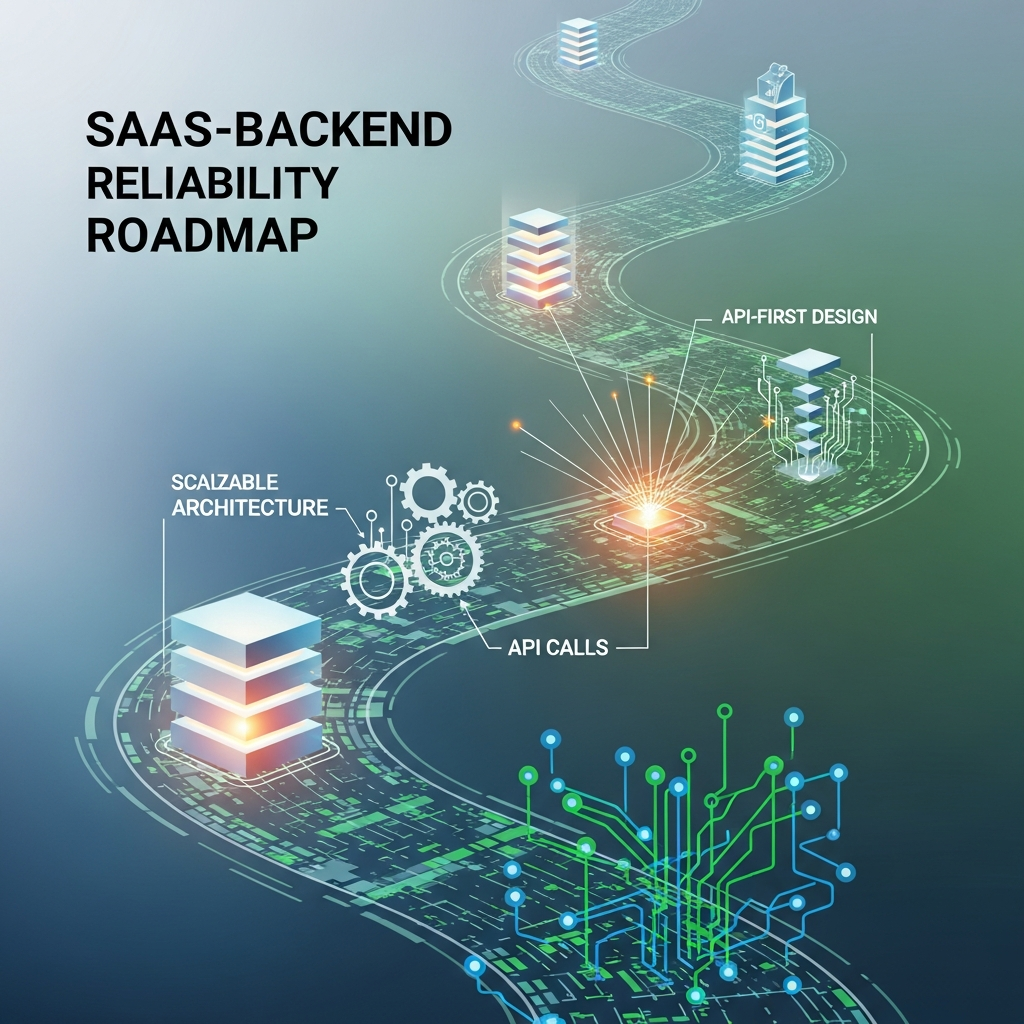
SaaS Backend Reliability Roadmap: Architecture, DevOps, and Patterns for Scalable SaaS
Why SaaS backend reliability matters
Reliability is a first-class product feature in modern SaaS. Customers buy outcomes, not just features. Availability, performance, and data integrity directly impact churn, expansion, and lifetime value. For product leaders and CTOs, reliability is inseparable from roadmap planning, architectural decisions, and vendor governance.
In practice, reliability translates to measurable goals: service level objectives (SLOs), error budgets, and concrete backups. The SaaS backend must weather regional outages, traffic spikes, and software failures without compromising data integrity or user experience. Achieving this requires a deliberate blend of architecture choices, disciplined DevOps practices, and a culture that treats outages as solvable events rather than inevitabilities.
This article lays out a practical, vendor-informed roadmap focusing on scalability, API-first design, and DevOps for SaaS reliability. We’ll cover patterns you can implement today, a multi-phase framework to evolve your backend over time, and guidance on selecting partners who can help you execute at scale.
Core reliability patterns for SaaS backends
Reliability is not a single feature; it’s an architectural discipline. The patterns below help you design systems that remain available, predictable, and secure as you grow. They also support experimentation, fast recovery, and predictable costs.
High availability and multi-region replication
High availability (HA) begins with data replication across regions and fault-tolerant services. Each critical data store should have synchronous or asynchronous replication to read/write replicas in multiple regions. The goal is to minimize latency for users while preserving data consistency guarantees appropriate to the data type. For SaaS, dispersed regions also soften the impact of regional outages and regulatory constraints, enabling compliant data residency when required.
Practically, your design should consider active-active deployments where feasible, automatic failover, and health checks that can steer traffic away from unhealthy regions. Balance consistency models with performance needs: strong consistency for critical financial data, eventual consistency for user-generated content and analytics, and clear conflict resolution policies.
Fault tolerance and graceful degradation
No system is perfectly resilient. Build for fault tolerance by isolating failures, implementing circuit breakers, and ensuring services degrade gracefully rather than fail catastrophically. Feature flags, graceful fallbacks, and cache-based resilience help maintain a usable experience even when parts of the system are temporarily unavailable.
Key practices include timeout budgets, retry strategies with exponential backoff, and clear user-facing messaging when a non-critical feature is temporarily unavailable. This approach reduces customer impact and preserves trust during incidents.
API-first SaaS architecture: benefits and pitfalls
An API-first mindset means every capability is designed as an API contract. This approach accelerates integration, supports multi-channel access (web, mobile, partners), and enables consistent governance across teams. API-first patterns align well with modular architectures and enable you to evolve behind stable interfaces.
Design principles
Start with clear resource modeling, idempotent operations, and explicit versioning. Use API gateways to enforce authentication, rate limiting, and quotas. Embrace stateless services where possible to simplify scaling and resilience.
Adopt robust contract testing to catch breaking changes before deployment. Document APIs with developer-friendly specifications, such as OpenAPI/Swagger, to reduce integration risk for customers and partners.
Versioning and backward compatibility
Favor semantic versioning and provide a clear deprecation timeline. Maintain stable public endpoints while evolving new capabilities behind newer versions. Provide automated tooling for customers to migrate gradually, with measurable migration progress and support.
DevOps for SaaS reliability
DevOps is the engine that turns architectural intent into reliable delivery. An effective DevOps discipline for SaaS blends continuous integration, continuous delivery, and Site Reliability Engineering (SRE) practices to minimize toil and maximize uptime.
CI/CD, testing, blue/green deployments
Automated tests across unit, integration, and end-to-end levels are essential. Use blue/green and canary deployments to minimize customer disruption when releasing new versions. Feature flags help separate release from rollout and enable rapid rollback if metrics deteriorate.
Infrastructure as code (IaC) enables repeatable environments and disaster recovery planning. Pair IaC with automated backups and periodic restore drills to validate recovery objectives (RPO/RTO) under real conditions.
SRE and error budgets
Adopt error budgets to manage operational risk. Define service-level indicators (SLIs) such as latency percentiles, error rates, and system availability. When error budgets are consumed, trigger review, halt non-critical features, and focus on incident remediation and governance improvements.
Scalable backend architecture for SaaS
Scalability is not just about handling more traffic; it’s about sustaining performance and cost control as you grow. A well-architected backend supports rapid feature delivery, predictable latency, and resilient data processing.
Microservices vs modular monolith
Microservices offer isolated failure domains and independent scalability, but introduce operational complexity. A modular monolith can deliver many of the same benefits with simpler deployment and governance when designed with clear module boundaries and well-defined APIs. Start with a modular monolith, then migrate to microservices as growth demands and operational maturity justify the added complexity.
Data layer design and replication
Choose data stores based on access patterns: relational databases for transactional integrity, NoSQL for flexible schemas, and specialized stores for time-series or graph data. Plan for read replicas, multi-region replication, and appropriate consistency guarantees. Implement intelligent caching and data locality strategies to reduce cross-region traffic and latency.
Observability and tracing
Observability is non-negotiable. Instrument services with metrics, logs, and traces that correlate user sessions with backend activity. Use distributed tracing to diagnose latency bottlenecks and coupling between services. Open standards like OpenTelemetry help unify telemetry across the stack and simplify tooling.
High availability SaaS patterns
High availability (HA) patterns address the inevitability of failures, whether due to regional outages, network problems, or software bugs. Core patterns include active-active and active-passive deployments, health-aware routing, and robust failure isolation.
Active-active vs active-passive
Active-active deployments run identical instances in multiple regions, serving user requests in parallel and sharing load. This minimizes latency and improves resilience but increases replication and consistency considerations. Active-passive setups keep standby environments ready to take over during failures, often with simpler synchronization but longer failover times.
Circuit breakers, bulkheads, retry strategies
Circuit breakers prevent cascading failures by stopping calls to unhealthy services. Bulkheads isolate failures within a service to prevent widespread impact. Design retry logic carefully to avoid retry storms that can amplify outages; implement exponential backoff and jitter to spread retry attempts over time.
Security and compliance considerations
Reliability and security go hand in hand. Secure architectures protect data integrity and availability, while compliance requirements (data residency, encryption standards, access controls) shape architectural decisions. Implement strong authentication, encrypted data in transit and at rest, and least-privilege access across services and teams.
Regular security testing, automated vulnerability scanning, and incident response playbooks are essential. Maintain clear governance around third-party integrations, API access, and vendor risk management to protect mission-critical SaaS backends.
Roadmap framework for reliability
To translate these patterns into a concrete plan, use a six-phase reliability roadmap. Each phase builds upon the previous one, with clear artifacts and success criteria.
- Discover and align: Define business and technical goals, map critical user journeys, and establish SLOs/SLA targets. Create a reliability charter that ties uptime and performance to product outcomes.
- Architect for resilience: Evaluate API-first design, data replication, and HA patterns. Draft architecture blueprints that support multi-region deployment and scalable data strategies.
- Implement core reliability patterns: Apply high-availability designs, fault tolerance, and observability. Establish incident response playbooks and runbooks for common failure modes.
- Codify DevOps for reliability: Set up CI/CD pipelines, automated testing, and blue/green deployment capabilities. Introduce SRE practices, error budgets, and post-incident reviews.
- Validate and optimize: Conduct disaster recovery drills, security audits, and performance benchmarks. Use real-user monitoring to validate SLOs in production and iterate on improvements.
- Scale with governance: Institutionalize design systems, API governance, and cross-team collaboration. Ensure vendor governance and ongoing capability maturation for long-term reliability.
Each phase yields tangible artifacts: architecture diagrams, HA patterns catalog, test plans, runbooks, and a governance model that can be handed to teams and vendors. The goal is a repeatable, auditable process that reduces time-to-value for reliability initiatives.
Vendor selection and partnerships
Choosing the right partner for SaaS backend reliability is as important as the technology itself. Look for vendors with proven experience in API-first architectures, multi-region deployments, and security/compliance programs relevant to your domain. Ask for architecture reviews, reference customers, and disaster recovery case studies that resemble your use case.
Key evaluation criteria include:
- Track record in your industry (FinTech, healthcare, etc.) and in regulated environments
- Explicit architecture choices aligned with API-first design and modularity
- Security posture, data governance, and compliance certifications
- Governance model for offshore/onshore delivery, including time zones and collaboration rituals
- Observability, incident management capability, and measurable ROI
Documented proofs of value—case studies, performance improvements, and concrete cost/benefit analyses—help translate engineering choices into business outcomes. When engaging, request a reliability assessment workshop or pilot to validate how the partner partners with your team on the roadmap.
Practical steps and checklists
Use the following practical checklist to bootstrap your SaaS backend reliability program. Adapt it to your product vertical and regulatory requirements.
- Define SLOs for key services and establish an error-budget framework.
- Map critical data flows and enforce data residency and encryption standards.
- Adopt an API-first design with stable contracts and versioning strategy.
- Design data replication, regional failover, and consistency models per data type.
- Implement observability: metrics, tracing, logs, and dashboards for all critical paths.
- Establish CI/CD with automated tests, blue/green deployments, and rollback plans.
- Set up incident response playbooks, on-call schedules, and runbooks for common failure modes.
- Introduce circuit breakers and bulkheads to isolate failures.
- Regularly practice disaster recovery drills and security audits.
- Institute design-system governance and API governance to scale with teams.
These steps create a repeatable, auditable process that scales with your product and keeps reliability at the center of development and delivery.
Case studies and real-world patterns
While each domain brings its own constraints, common patterns emerge across FinTech, healthcare, and SaaS platforms. A typical journey begins with regional replication to reduce latency, followed by a structured incident management program and a gradual migration from monolithic to modular architectures. Organizations that invest in observability—instrumenting services, tracing critical calls, and tying metrics to customer outcomes—tend to shorten incident dwell time and improve customer satisfaction. The most successful programs also align reliability initiatives with product management goals, ensuring that uptime, performance, and data integrity directly contribute to retention and revenue growth.
In practice, a midsize SaaS provider might start with multi-region read replicas, introduce circuit breakers around payment services, and implement a standardized runbook for incidents. Over time, they shift toward API-first microservices with centralized governance, enabling faster feature delivery while maintaining control over security and compliance. These patterns reduce churn, improve user trust, and create a scalable platform foundation for growth.
Getting started: CTO action plan
If you’re a CTO or product leader ready to embark on a reliability journey, here is a practical starting plan:
- Set a baseline: measure current SLOs, MTTR, latency, error rates, and data loss across critical paths.
- Define target architecture: decide between multi-region HA, API-first contracts, and a modular design that supports future growth.
- Prioritize quickly-impactful items: multi-region replication, observability, and CI/CD improvements.
- Establish governance: create an reliability charter, runbooks, and an ongoing vendor evaluation process.
- Plan a pilot: run a 90-day reliability pilot with defined success metrics and a clear handoff to teams.
By following these steps, you can translate architectural patterns into concrete business value, reduce churn, and enable rapid scaling without compromising security or compliance.