
Pilot‑to‑Production Roadmap for Autonomous Agents: Metrics, Monitoring and Integration Patterns
- all
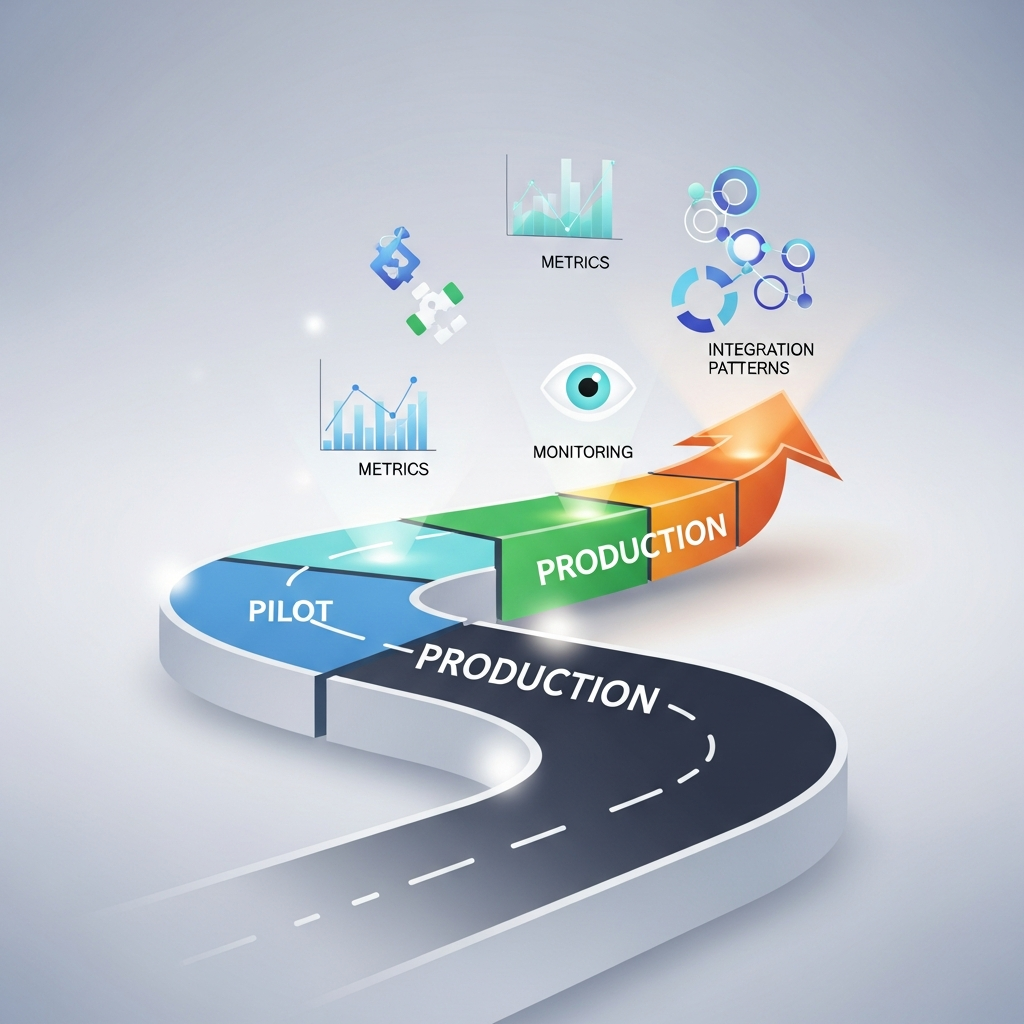
Pilot-to-Production Roadmap for Autonomous Agents: Metrics, Monitoring and Integration Patterns
Introduction: Why a formal pilot-to-production roadmap matters
Organizations increasingly deploy autonomous agents to automate repetitive decision-making, data gathering, and execution across business processes. A successful pilot demonstrates technical feasibility, but turning that pilot into a reliable, scalable production service requires a repeatable blueprint. This article provides a practical roadmap focused on metrics, monitoring, and integration patterns to help engineering managers and product operations teams adopt autonomous agents roadmap with confidence.
While pilots often prove technical viability, production-grade agents demand disciplined governance, robust telemetry, and careful integration with existing data stores, security regimes, and orchestration layers. A well-defined path reduces risk, clarifies ownership, and accelerates time-to-value for the enterprise. By following a structured approach, teams can scale agents across domains—customer service, operations, compliance, and decision-support—without sacrificing reliability or security.
Throughout this guide, we emphasize a repeatable pattern that translates pilot success into durable production capabilities. You will find concrete artifacts, governance mechanisms, and practical checklists designed for engineering managers and product ops teams who are ready to scale responsibly.
Defining the Roadmap: Scope, boundaries, and return on investment
Begin by outlining two horizons: the pilot's proven capabilities and the production requirements that will enable scaling. This phase includes establishing success criteria, identifying critical data sources, and defining non-functional requirements such as latency, reliability, security, and compliance. The goal is to create a concrete, auditable plan that teams can execute in a repeatable fashion.
Step 1: delineate what moves from pilot to production. Distinguish core agent capabilities (the components that must endure in production) from experimental features (which can be iterated or sunset). Document data contracts, APIs, and required safeguards. This clarity prevents scope creep and ensures teams build for maintainability from day one.
Step 2: set measurable ROI targets. Map production requirements to quantifiable outcomes: improved cycle times, reduced error rates, uplift in customer satisfaction, risk reductions, and cost savings. Tie each target to concrete metrics and a cadence for review with leadership and stakeholders.
To operationalize ROI, translate strategic goals into a dashboard of rolling targets: delivery speed, reliability, and value realization. Align the roadmap with portfolio management, so executives can see how each production feature contributes to the bottom line. This disciplined approach reduces risk and creates a clear path from pilot to scaled production.
Metrics That Matter for Autonomous Agents
Measuring the performance of autonomous agents requires a balanced scorecard spanning operational, technical, and business outcomes. A well-chosen metric set helps you detect drift, justify investments, and guide continuous improvement.
3.1 Operational metrics
- Task completion rate: the percentage of tasks finished as expected without manual intervention.
- Average time to decision: how long an agent takes to reach a binding conclusion.
- Time to recovery after a failure: how quickly the system returns to normal after incident.
- Mean time between incidents (MTBI): the durability of the production agent in production.
- Service level indicators (SLIs) and service level objectives (SLOs) for agent tasks.
- Error budgets that balance velocity with reliability.
Operational metrics provide a direct read on the health of production agents, guiding daily decisions and quarterly planning.
3.2 Quality and safety metrics
- False-positive and false-negative rates for agent decisions.
- Rate of human-in-the-loop interventions and escalation frequency.
- Frequency of unsafe or insecure actions and the presence of guardrails.
- Compliance with CI/CD guardrails and safety checks embedded in development workflows.
- Explainability and interpretability scores for AI-driven decisions.
Quality and safety metrics ensure that agents behave within desired boundaries while maintaining transparency for audits and governance.
3.3 Business outcomes
- Workflow impact: improvements in throughput and process cycle times.
- Reduction in manual effort and operational costs.
- Gains in customer outcomes and satisfaction scores.
- Onboarding efficiency and new user activation rates.
- Cross-team adoption and velocity of feature delivery.
Translate agent performance into business value by mapping these metrics to ROI calculations and quarterly business reviews. Create dashboards that surface these metrics to executives, product teams, and site reliability engineers to ensure alignment with goals.
Monitoring and Telemetry: Instrumentation blueprint
Telemetry forms the backbone of production-grade autonomous agents. It provides visibility into behavior, performance, and risk, enabling rapid detection of anomalies and proactive remediation. A robust telemetry strategy includes data collection, correlation, storage, and actionable alerts.
4.1 Telemetry architecture
Design a layered telemetry model: concrete signals from agents (inputs, decisions, actions), system signals (CPU, memory, network), and business signals (outcomes, impact). Correlate events across the agent stack with unique identifiers to enable end-to-end tracing. Centralize logs, metrics, and traces in a scalable observability platform, and apply deterministic sampling to keep data volumes manageable while preserving essential signals.
Automate anomaly detection with threshold-based alerts and machine learning-based drift detection. Ensure alert fatigue is minimized by tuning severity, routing alerts to the right teams, and implementing runbooks for common incidents.
Integration Patterns: Melding autonomous agents with enterprise systems
Agents rarely operate in isolation. They must exchange data with ERP, CRM, data warehouses, knowledge bases, and monitoring tools. Adopting robust integration patterns reduces brittleness and accelerates time to value.
5.1 API-first design
Adopt an API-first approach to enable modular, decoupled architecture. Define stable contracts, versioned APIs, and clear data schemas. Use event-driven messaging where possible to minimize coupling and improve responsiveness.
5.2 Data governance and security
Agent integration requires strict data governance. Implement data minimization, encryption at rest and in transit, access controls, and auditing. Align with regulatory requirements (e.g., privacy and security standards) and establish data lineage for traceability.
Agent Lifecycle Management: From birth to retirement
Lifecycle discipline is essential for production-ready agents. A formal lifecycle ensures reproducibility, traceability, and governance across the agent's lifespan.
6.1 Onboarding and configuration
Document the acceptance criteria, data sources, and configuration parameters for each agent. Use a repeatable provisioning workflow to deploy agents into staging and production with standard security baselines and audit trails.
6.2 Versioning and rollback
Treat agents as versioned software with clear upgrade paths. Maintain a rollback plan, blue/green deployment options, and reversible feature flags. Regularly test rollback scenarios in a safe environment to minimize production risk.
Architecture Patterns and Platform Considerations
Choose architectural patterns that promote scalability, resilience, and security. The right combination of microservices, event-driven design, and orchestration frameworks sets the foundation for long-term success.
7.1 Orchestration and event-driven design
Leverage orchestration tools to manage multiple agents and their interactions. Event-driven architectures use asynchronous messaging to improve responsiveness and fault isolation. Prioritize loose coupling and observable workflows to simplify maintenance and upgrades.
7.2 Observability and resilience
Implement end-to-end tracing, metrics, and log aggregation to diagnose issues quickly. Use circuit breakers, retries with backoff, and graceful degradation to maintain service quality during partial failures.
Governance, Compliance, and Risk Management
Production agents operate in a regulated landscape in many industries. A governance framework clarifies ownership, risk appetite, and compliance requirements, ensuring that agents behave within defined norms while delivering measurable value.
Establish product, security, and data governance committees with cross-functional representation. Create playbooks for incident response, data breach notification, and regulatory audits. Regularly review risk dashboards and align with business objectives.
Roadmap Template: A practical 12-step plan
- Define success criteria and ROI targets for production deployment.
- Map pilot capabilities to production requirements and data contracts.
- Establish an architecture blueprint combining API-first design and event-driven patterns.
- Instrument comprehensive telemetry and observability from day one.
- Set SLOs and SLIs with clear alerting and runbooks.
- Define data governance, security controls, and regulatory mapping.
- Design integration contracts with ERP/CRM systems and data lakes.
- Implement a lifecycle management process with versioning and rollback.
- Develop a resilient deployment strategy (blue/green, canary, feature flags).
- Establish governance bodies and reporting cadence for executives.
- Run design and architecture reviews before any production promotion.
- Launch a staged production ramp with continuous improvement loops.
Each step should be accompanied by concrete artifacts: data contracts, API schemas, SLO definitions, incident response playbooks, and a measurable set of outcomes that align with ROI targets.
Real-World Scenarios and Common Pitfalls
Enterprises face recurring challenges when moving from pilot to production. Proactively addressing these issues increases the odds of a successful transition.
Scenario 1: Finite data quality in production
When data quality degrades in production, agent performance suffers. Mitigate by establishing data quality gates in CI/CD, continuous data cleansing pipelines, and data lineage tracking. Invest in data stewardship to maintain accuracy over time.
Scenario 2: Security and compliance drift
Security drift happens when guardrails are loosened during rapid expansion. Enforce baseline security configurations, regular penetration testing, and automated compliance checks as part of the deployment pipeline.
Scenario 3: Integration churn
APIs evolve; contracts must be versioned. Maintain backward compatibility, provide clear deprecation timelines, and implement feature flags to isolate changes that might impact downstream systems.
These patterns help teams anticipate risks and maintain velocity while preserving reliability and trust in autonomous agents.
Next Steps: How to start with a repeatable approach
If you're ready to adopt an autonomous agents roadmap, start with a structured workshop to align leadership on goals, metrics, and governance. Build a pilot-to-production plan that emphasizes the artifacts described above and establishes a cadence for measurement and iteration.
Consider partnering with a technology velocity team that can provide end-to-end product engineering, cloud-native architecture, and security governance—capabilities that are essential for scaling autonomous agents in regulated environments. Begin with a small, measurable production pilot, then expand scope as you validate ROI and reliability.
This approach supports a repeatable pattern for other domains, enabling faster time-to-value, safer deployments, and a clear pathway to scale autonomous agents across the organization.