
MVP-Prototype Playbook
- all
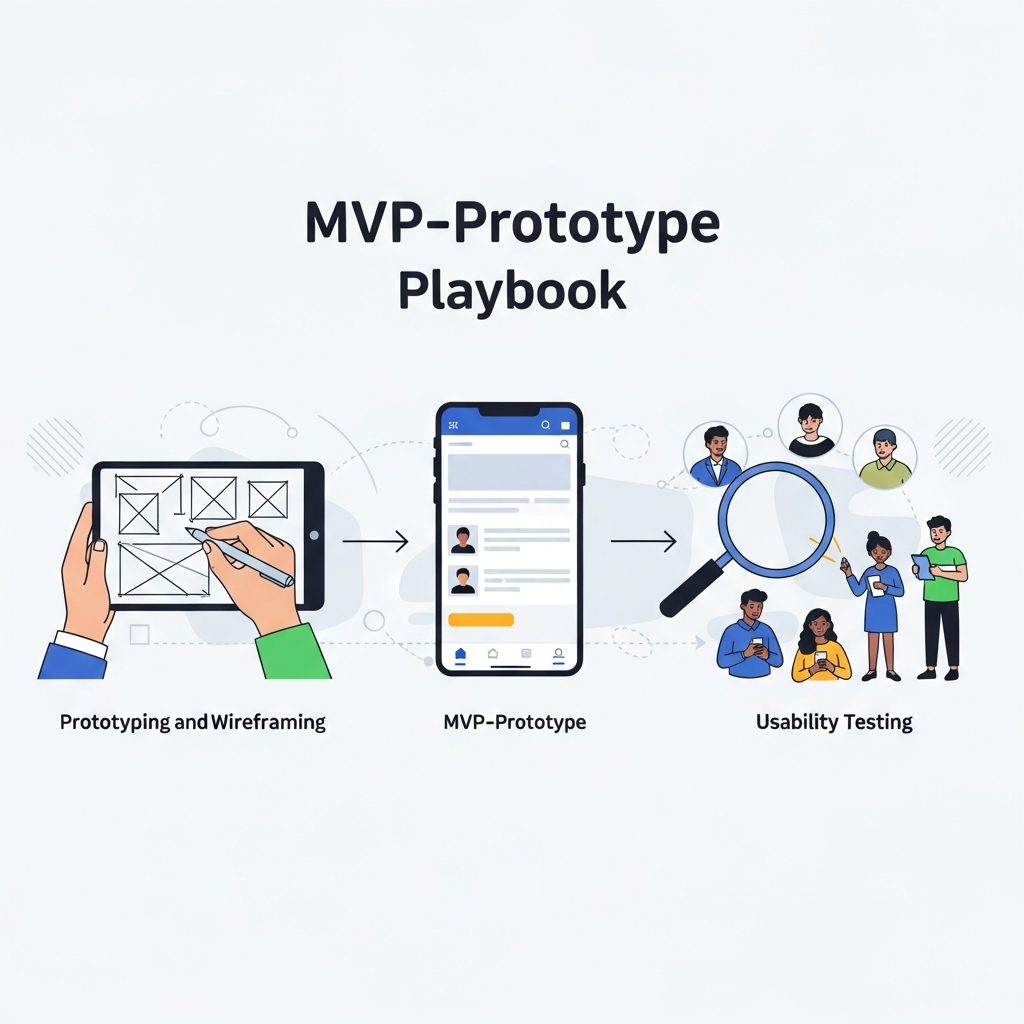
MVP-Prototype Playbook
Introduction: What is the MVP prototyping process and why it matters
In fast-moving markets, startups and product teams need to validate ideas without overinvesting. The MVP prototyping process is a structured approach to translate vague concepts into testable experiences. It emphasizes rapid iteration, user feedback, and learning over perfection.
When executed well, prototyping is not merely about a looks-like, works-like interface; it’s a tool for risk reduction. It reveals whether a product concept resonates with real users, exposes critical assumptions, and guides resource allocation for development. This playbook distills practical methods to prototype, test, and validate an MVP quickly and with purpose.
Throughout this guide, you’ll encounter concrete steps, templates, and decision points you can adapt to your team’s context. The focus remains on actionable methods that shorten time-to-market while preserving learning quality.
Planning Your MVP Prototype: Goals, Metrics, and Stakeholders
Begin with clarity. Define two or three concrete outcomes you want from the MVP experiment. Common goals include validating product-market fit, proving a key user flow, or achieving a minimum viable experience that can attract early adopters or investors.
Map the critical risks you need to test. Typical bets include whether users understand a value proposition, whether the onboarding flow converts, or whether a proposed feature creates meaningful engagement. Write these as testable hypotheses.
Choose metrics that reflect real value. Activation rate, time-to-first-value, task success rate, and retention after first use are standard MVP metrics. Tie success to a quantitative threshold (for example, 40% activation within the first 24 hours) and a qualitative signal (user confidence in the core idea).
Identify stakeholders and roles. Decide who owns the MVP, who provides feedback, and who signs off on the prototype’s scope. A lean governance model—clear decision rights and a short feedback loop—reduces cycles and keeps momentum.
Prototyping and Wireframing: From Sketches to Clickable Concepts
Start with low-fidelity artifacts to capture intent quickly. Sketches, storyboards, and paper prototypes help you explore flows without getting stuck in pixels. The goal at this stage is to validate structure, not to achieve visual polish.
Progress to wireframes, then to clickable prototypes. Wireframes establish information architecture, navigation, and key interactions. A clickable prototype demonstrates the chosen flow and allows testers to perform tasks with a realistic sequence.
Choose your tooling based on speed and feedback needs. Tools like wireframing apps and lightweight prototyping platforms enable rapid iteration. Ensure your prototypes are shareable with testers and stakeholders to gather diverse perspectives without heavy lift.
Balance fidelity with learning. Higher fidelity can reveal subtle usability issues, but it also risks anchoring opinions to visuals. Use a staged approach: start with skeletons, escalate to mid-fidelity, and reserve high-fidelity for final validation sprints.
Key considerations for prototyping
- Prioritize the core value path a user takes to reach value quickly.
- Preserve the concept’s constraints; avoid feature creep in early prototypes.
- Ensure test scenarios map to real user tasks (not hypothetical lab activities).
Design Sprint for Startups: A Practical Framework
Design sprints compress weeks of work into a focused, time-bound process. A typical sprint spans four to five days and emphasizes decision making, rapid prototyping, and user feedback. For startups, a sprint can clarify value propositions, align teams, and de-risk ambitious roadmaps.
Week-by-week structure (condensed):
- Day 1 – Understand and map: Define the long-term goal, identify user needs, and map the critical path to value.
- Day 2 – Sketch and ideate: Generate a wide range of solutions, from clever new approaches to small tweaks to flows.
- Day 3 – Decide and decouple: Review ideas, vote, and select a feasible concept to prototype.
- Day 4 – Prototype: Build a realistic representation of the chosen concept, focusing on the core user journey.
- Day 5 – Test and learn: Validate with real users or stakeholders and decide whether to pivot, persevere, or proceed to MVP development.
For startups, design sprints provide a disciplined cadence for experimentation. They’re not a substitute for product development, but they create a strong foundation for MVP decisions and align engineering, design, and product teams around a validated path.
Usability Testing for MVP: Methods and Best Practices
Usability testing helps you observe how real users interact with your prototype and reveals where friction prevents value realization. Aim for early and iterative testing to catch usability problems before you invest in building the full product.
Test design matters as much as the participants. Create realistic tasks that reflect genuine user goals. Use a think-aloud protocol to capture user reasoning, but also consider post-task interviews to surface reflections you wouldn’t observe in real-time.
Sampling and cadence matter. A common rule of thumb is 5-8 participants per test round, repeating cycles as you learn. For MVPs, even a handful of sessions can surface critical issues if you choose representative users and test critical flows—onboarding, core value delivery, and key interactions.
Data capture should be structured. Use a simple rubric for success, time-to-complete, error frequency, and subjective satisfaction. Record sessions (with consent) to analyze patterns and inform iteration priorities.
Common usability issues to watch for include confusing navigation, ambiguous CTAs, mismatch between user mental model and interface flow, and performance bottlenecks that interrupt the core journey to value.
Validate Product Market Fit: Experiments that Reveal Signal
Product-market fit is a moving target for early-stage products. Your MVP prototype should generate signals about whether customers will pay for the core value you offer. Design experiments that isolate the most risky assumptions and produce measurable learning.
Experiment types include concierge MVPs, smoke tests, and onboarding experiments. Concierge MVPs test the experience manually before automating constructs. Smoke tests validate demand with landing pages, waitlists, or pre-orders to gauge interest without full product construction.
Define success criteria before experiments begin. For example, you might require a minimum conversion rate from landing page visitors to signups, or a target activation rate within the first session. Publish results to stakeholders to align roadmap decisions with evidence.
Interpreting results requires nuance. A single negative outcome doesn’t kill an idea; it may refine the value proposition, target segment, or onboarding flow. Use results to inform iterative loops, not to justify an all-or-nothing pivot.
MVP Development Steps: A Practical Playbook
Turn insights from prototyping and testing into an action plan for MVP development. Following a structured sequence helps teams move from concept to a testable product quickly while preserving focus on learning goals.
- Define scope and success metrics: Nail down the core value, the primary user journey, and the minimum feature set needed to test the hypothesis.
- Architect for speed and learning: Choose a tech approach that supports rapid iteration (API-first, modular design, scalable backend). Plan instrumentation early to capture learning signals.
- Build a lean backend and front-end: Implement only what’s necessary to validate the core experience. Use feature flags to enable quick changes without code redeployments.
- Fabricate data and test harnesses: Create synthetic or sample data to simulate real-world usage and accelerate testing without risking real data.
- Test with real users: Execute usability sessions and A/B tests where feasible. Gather qualitative feedback and quantitative signals in parallel.
- Iterate and decide: Prioritize refinements that improve the path to value. Decide whether to pivot, persevere, or advance to a broader MVP.
Keep the MVP iteration loop tight. A typical MVP cycle runs in a few weeks, with another short loop after feedback to confirm learnings before full-scale development.
Important notes on architecture decisions: favor composable services and clear API boundaries. This reduces risk if you later scale or pivot, and it supports partner integrations that may be essential for MVP viability.
Templates, Checklists, and Deliverables
Templates help teams stay aligned and speed up execution. Consider these essentials:
- A test plan aligned to your MVP hypotheses, with defined success metrics and acceptance criteria.
- A prototype specification document detailing user journeys, required interactions, and data flows.
- A usability testing script and a rubric for scoring results.
- A sprint agenda and a decision log to surface trade-offs and confirm next steps.
- An MVP plan outlining scope, timeline, and resource estimates for the build phase.
Deliverables to expect from an effective MVP program include a validated prototype, user feedback synthesis, and a prioritized backlog for MVP development. These artifacts create a defensible path for investors and internal stakeholders alike.
Pitfalls and Trade-offs: How to avoid common missteps
Two frequent traps derail MVP efforts: scope creep and premature optimization. Define a tight scope at the outset and resist adding features unless they test a validated hypothesis. Don’t optimize for aesthetics at the expense of learning.
Another pitfall is testing with non-representative users. Seek participants who reflect actual users and use authentic tasks that mirror real workflows. Be wary of letting internal biases shape interpretation; rely on structured data and independent observers whenever possible.
Trade-offs are inevitable. A lean MVP prioritizes speed over polish, while a more ambitious MVP might trade speed for a broader feature set. Make decisions explicit, document the rationale, and ensure all stakeholders understand the implications for learning and budgeting.
Conclusion: Turning prototypes into real value
The MVP prototyping process is a disciplined approach to learning fast. By combining planning, prototyping, design sprints, usability testing, and validated experiments, teams can reduce risk and accelerate time-to-market. The objective is not to ship a perfect product but to learn quickly what customers truly value and what to build next.
As you move from prototype to MVP, keep the focus on learning metrics, a lean architecture that supports iteration, and a feedback loop that informs a real product roadmap. With this playbook, your team can navigate uncertainty, test assumptions, and emerge with a credible path to product-market fit.
If you’d like help tailoring this MVP prototyping process to your organization or need hands-on guidance through a sprint or prototype run, consider engaging a partner with experience in rapid prototyping, usability testing for mvp, and design sprint for startups. The right collaboration can compress months of decision-making into a few focused weeks and set you up for meaningful investor conversations and product success.