
Field-Proven Use Cases: Marketing, Sales, Operations and Product Examples
- all
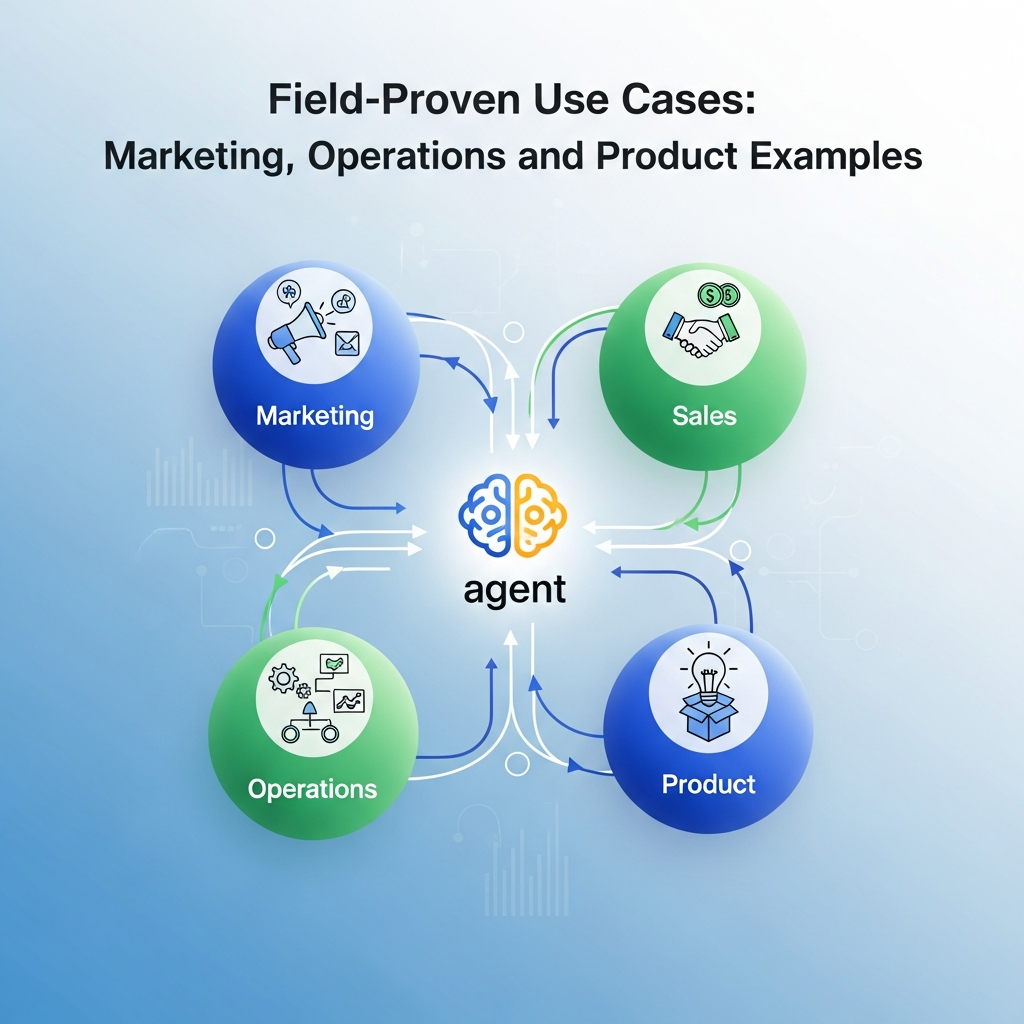
Agentic Use Cases: Field-Proven Marketing, Sales, Operations and Product Examples
What are Agentic Use Cases?
Agentic use cases describe how autonomous agents—designed to act on data, reason about outcomes, and execute concrete tasks—augment human teams across marketing, sales, operations, and product development. These agents are not mere chatbots; they combine decisioning, action, and orchestration to close the loop from insight to impact. In practice, an agent might analyze a dataset, propose a course of action, approve a workflow, and trigger downstream systems without manual handoffs at every step.
When implemented thoughtfully, agentic patterns reduce time-to-value, eliminate repetitive toil, and unlock new capabilities at scale. The objective is to create accountable, observable agents that align with business goals, integrate with existing stacks, and operate within guardrails—privacy, security, and compliance—appropriate to each domain.
For product, operations, and GTM leaders, the essential framing is a lifecycle: sense, decide, act, learn. This loop becomes the backbone of agentic use cases, enabling measurable improvements in efficiency, quality, and customer outcomes while preserving human oversight where it adds the most value.
Agentic Marketing
In marketing, agentic capabilities accelerate customization, experimentation, and optimization across channels. An agent can continuously monitor campaign performance, adjust creative assets, and allocate budget to the highest-performing channels in real time. Below are representative patterns and practical considerations.
Patterns and practical patterns
- Automated content generation and optimization: Agents draft social posts, email copy, and landing page variants, then run controlled experiments to identify winning variants. They can also adapt tone and messaging based on audience segments and performance signals.
- Personalized journey orchestration: Agents map user signals (behavior, intent, lifecycle stage) to tailored paths, routing experiences through the most effective channels and messages at each touchpoint.
- Campaign budgeting and optimization: Agents monitor cost-per-acquisition, conversion rate, and creative performance, reallocating spend dynamically to maximize ROI while maintaining governance constraints.
Implementation tips
- Start with a narrow, measurable objective (e.g., improve email CTR by 15% within 4 weeks) and a constrained data set for quick validation.
- Ensure data quality and governance: clean, labeled datasets; clear data lineage; and privacy safeguards.
- Design guardrails for automation: set budgets, thresholds, and human review checkpoints to prevent runaway actions.
Illustrative example: An agent analyzes historical campaign data, generates subject lines, and tests variants in a controlled A/B framework. The agent then shifts spend toward the best-performing variant and automatically updates landing pages to reflect optimized messaging, while a human supervisor reviews results weekly to validate strategic direction.
Agentic Sales Processes
Sales teams benefit from agents that can triage leads, schedule meetings, and keep CRM data fresh. Agentic sales processes reduce time-to-qualify and accelerate motion from inbound inquiry to opportunity creation. Here are core patterns and practical steps to adopt.
Patterns and practical patterns
- Lead qualification and routing: An agent analyzes lead signals (ICP fit, engagement history, intent signals) and categorizes prospects by readiness. It routes qualified leads to the right SDR or account executive with recommended next steps.
- Automated outbound sequencing: Agents craft and send personalized outreach sequences based on buyer persona, industry, and lifecycle stage, adjusting cadence in response to engagement.
- Meeting scheduling and CRM updates: An agent proposes meeting times, books slots (via calendar APIs), and auto-populates CRM with context, notes, and next actions for reps.
Implementation tips
- Define clear qualification criteria and decision thresholds to avoid over-automation of complex deals.
- Integrate with core sales tooling (CRM, calendar, marketing automation) and ensure data synchronization.
- Monitor quality of outbound interactions and maintain a human-in-the-loop review process for high-value opportunities.
Illustrative example: A sales agent monitors inbound inquiries in a B2B SaaS context, scores them against ICP and intent signals, assigns the most relevant rep, and automatically schedules a discovery call. The agent also attaches a context-rich note in the CRM and triggers a follow-up sequence if the prospect engages with the initial outreach.
Operations Automation with Agents
Operations teams face repetitive workflows, data gathering, and exception handling. Agentic automation can orchestrate cross-functional tasks, accelerate incident response, and improve data quality. Consider these patterns and practicalities.
Patterns and practical patterns
- Workflow orchestration and triage: Agents coordinate approvals, gather required documents, and route tasks to the right teams with SLAs and escalation rules.
- Data integrity and reconciliation: Agents compare data across systems, flag discrepancies, and initiate correction workflows, reducing manual reconciliation effort.
- Incident response automation: Agents monitor system telemetry, trigger playbooks, and coordinate with on-call engineers, while preserving audit trails.
Implementation tips
- Map end-to-end processes first; identify bottlenecks where an agent can add the most value without sacrificing control.
- Institute governance: define ownership, change management, and rollback procedures for automated workflows.
- Pair agentic automation with strong observability: dashboards, logs, and alerts to verify outcomes and detect drift quickly.
Illustrative example: An IT operations team deploys an agent to monitor ticket queues, triage based on priority, auto-create tickets in a ticketing system, and notify stakeholders for high-severity incidents, with an on-call escalation path if thresholds are exceeded.
Product Automation Scenarios
Product teams leverage agents to optimize development lifecycles, A/B testing of features, and user onboarding. These scenarios emphasize learning loops and governance-friendly experimentation.
Patterns and practical patterns
- Experimentation and feature rollout: Agents manage feature flags, monitor outcomes, and promote or rollback features based on predefined success metrics.
- Onboarding optimization: Agents guide new users through setup, collect preferences, and tailor onboarding steps to individual needs, reducing time-to-first-value.
- Product analytics and insights: Agents summarize usage data, surface actionable insights, and propose next experiments for product teams.
Implementation tips
- Start with a minimal viable experiment framework: define objective, success metric, and a single actionable outcome.
- Integrate with product analytics and telemetry to feed agent decisioning with reliable signals.
- Establish guardrails to prevent unintended feature exposure or data leakage during automated experiments.
Illustrative example: A fintech SaaS product uses an agent to test a new onboarding flow. The agent monitors completion rate, drop-off points, and time-to-activate, then adjusts the UX paths and sequences to push engagement, all while recording results for post-hoc evaluation by product leaders.
Implementation Playbook
Adopting agentic patterns requires a structured approach. This playbook outlines a practical path from discovery to governance, with phased milestones and tangible deliverables.
Phased plan overview
- Phase 1: Discovery and scoping — identify high-impact processes, quantify potential ROI, and establish success criteria. Define guardrails and risk thresholds.
- Phase 2: Data readiness and integration — audit data sources, ensure quality, and design data pipelines that feed agent decisioning. Plan for privacy and security compliance.
- Phase 3: Architecture and governance — select an architectural model (API-first, modular microservices), define ownership, and establish change-management processes.
- Phase 4: Pilot and validate — run a controlled pilot with a single process, measure outcomes, and iterate before broader rollout.
- Phase 5: Scale and operate — expand to additional use cases, implement observability, and embed continuous improvement loops.
Key success factors
- Strong data governance and privacy controls from day one.
- Clear decision ownership and escalation paths for automated actions.
- Incremental, observable value with explicit milestones and reviews.
Practical steps you can take this quarter: assemble a cross-functional pilot team, define a single end-to-end process to automate, map data lineage, and draft a 90-day pilot plan with monthly check-ins and a go/no-go decision point.
Vendor Evaluation & Governance
Choosing a partner to implement agentic use cases requires more than a great demo. You need a framework for evaluation, governance, and ongoing accountability. Consider these dimensions as you shortlist vendors and design engagement models.
Evaluation criteria
- Technical depth: API-first design, data quality controls, security posture, and observability.
- Industry alignment: domain experience in marketing, sales, operations, or product, and familiarity with your data sources and compliance needs.
- Engagement flexibility: dedicated teams, staff augmentation, or project-based partnerships with clear SLAs.
- Governance and transparency: governance frameworks, change control processes, and reporting cadence.
Governance blueprint
- Define decision ownership and escalation rules for automated actions.
- Institute data lineage and auditing for all agent-driven decisions and actions.
- Establish security and privacy controls aligned to your regulatory context.
Tip: Start with a signed pilot agreement that includes a narrow scope, fixed milestones, and a clear path to broader deployment upon successful validation.
Case Studies and Lessons Learned
Below are illustrative, real-world-inspired patterns drawn from industry practice. They are designed to help you translate agentic concepts into actionable roadmaps without assuming any single vendor path.
Case Study A: Marketing efficiency uplift
A mid-market software company piloted an agent that drafted content variants and orchestrated cross-channel campaigns. Within eight weeks, the team observed faster experimentation cycles, higher content relevance, and more consistent brand messaging across channels. The agent also compiled a quarterly ROI report summarizing initiative outcomes and recommendations for scaling to additional products.
Case Study B: Revenue operations acceleration
In a B2B SaaS environment, an agent managed lead qualification and meeting scheduling, while auto-updating CRM with contextual notes. The outcome was a shorter cycle from inbound inquiry to discovery call and a measurable improvement in sales-ready leads per week. The team maintained oversight with weekly governance reviews and a safety rubric for exceptions.
Lessons learned
- Guardrails are essential: clear thresholds and escalation rules prevent unintended consequences in automated actions.
- Quality data is foundational: data quality directly correlates with agent decision quality and downstream outcomes.
- Progress requires a design system: consistent patterns, decisions, and UI cues improve adoption and reduce cognitive load for users interacting with agents.
Getting Started
Ready to begin your agentic journey? Use this practical starter checklist to move from concept to first value within 90 days.
Quick-start checklist
- Identify a single high-impact process in marketing, sales, operations, or product to automate first.
- Audit data sources and establish a minimal data pipeline to feed agent decisioning.
- Define success metrics and a phased rollout plan with explicit milestones.
- Map governance, ownership, and escalation rules for automated actions.
- Choose a partner with a track record in API-first architectures and secure, scalable delivery.
As you progress, expand to adjacent use cases and continuously refine guardrails, data quality, and observability. The journey is iterative by design; celebrate small wins and align them to broader business outcomes.