Estimating Total Cost of Ownership for Custom Platforms
- all
Estimating Total Cost of Ownership for Custom Platforms
What is total cost of ownership for custom software?
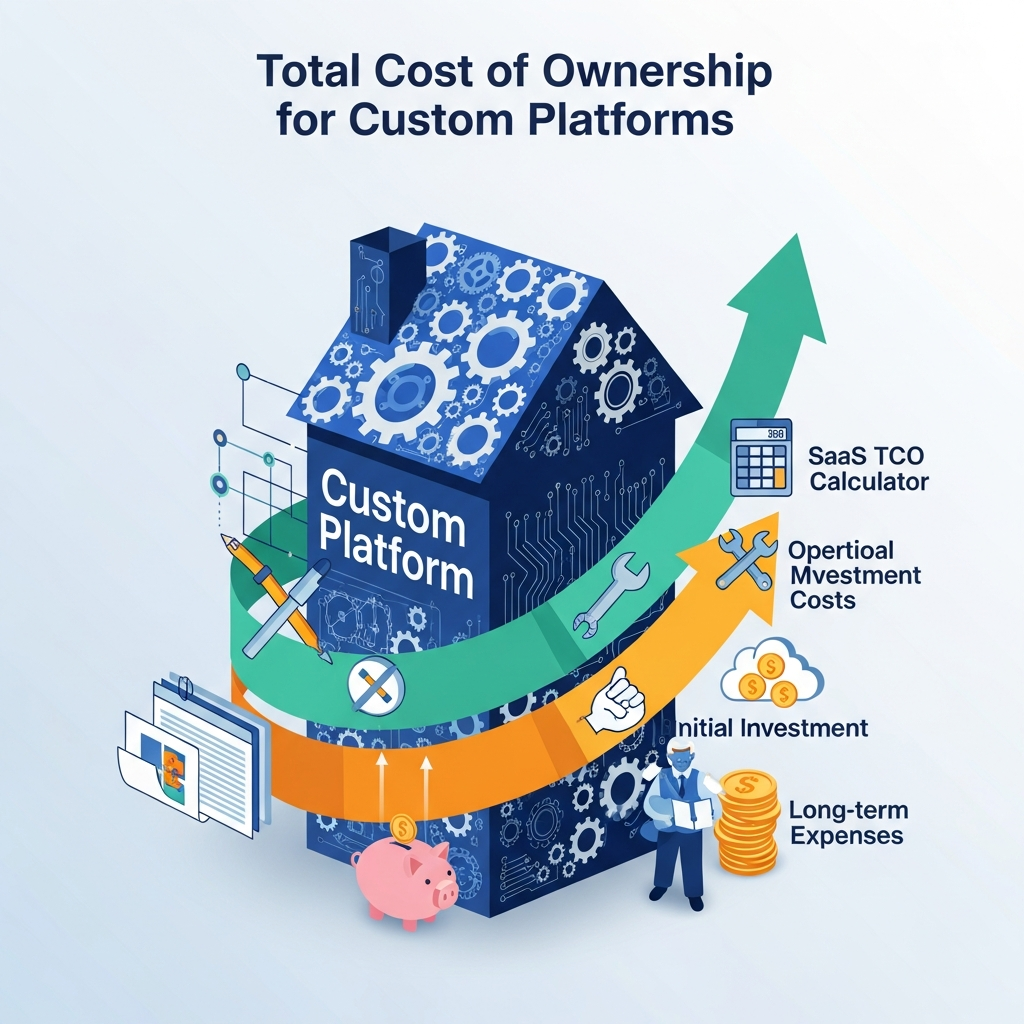
Total cost of ownership (TCO) for a custom software platform is a holistic view of all costs incurred over the system's life cycle, from idea to sunset. It goes beyond initial development spend to include ongoing maintenance, security, hosting, upgrades, and end-of-life planning. For CTOs and product leaders, TCO helps compare a bespoke build with off-the-shelf or SaaS alternatives on a like-for-like basis. It also clarifies how early design decisions affect long-term budgets, risk posture, and strategic flexibility.
When you evaluate TCO for a custom platform, you’re not just tallying dollars. You’re mapping people, processes, and technology across three horizons: initial delivery, steady-state operations, and future evolution. A robust TCO model supports budgeting conversations with executives, informs negotiation with vendors, and creates defensible roadmaps for modernization or greenfield programs.
Cost categories in a TCO model
A comprehensive TCO model breaks costs into categories, making it easier to spot hidden or often overlooked areas. The most impactful categories typically include:
- Development and delivery costs (vadidation, architecture, coding, testing)
- Cloud hosting and platform infrastructure (compute, storage, networking, data transfer)
- Third-party licensing and SaaS services (databases, analytics, identity, monitoring)
- Security, compliance, and risk management (audit trails, encryption, penetration tests)
- Maintenance, support, and operations (bug fixes, upgrades, SRE/DevOps)
- Governance, documentation, and training (policy, knowledge transfer, onboarding)
- Depreciation and financing (if arising from capex investments)
Each category carries its own set of assumptions and uncertainty. A disciplined approach uses explicit assumptions, ranges, and sensitivity analysis to show how results shift with changes in demand, scale, or regulatory requirements.
Direct vs indirect costs
Direct costs are expenses tied to tangible activities and assets, such as developer salaries, cloud credits, or license fees. Indirect costs arise from the organizational impact of the project, including management time, disrupted workflows, or the opportunity cost of selecting one architecture over another. A complete TCO evaluation captures both:
- Direct: salaries, contractor fees, cloud instances, licenses, data storage, security tooling
- Indirect: time spent by executives in governance, reduced productivity during migrations, and potential market opportunity costs
In practice, indirect costs are often the largest source of variance in long-running programs. A transparent model that explains these factors supports better decision-making and reduces stakeholder friction.
Build vs buy: factoring TCO into the decision
One of the core reasons for calculating TCO is to sharpen the build-vs-buy discussion. A bespoke platform offers tailored capabilities and competitive differentiation, but it may incur higher upfront investment and ongoing maintenance burdens. SaaS or off-the-shelf solutions can reduce some ongoing costs, yet may require compromises in customization or data portability.
A practical TCO approach compares scenarios on a like-for-like basis. For each option, you quantify: initial costs, recurring costs, maintenance, and upgrade cycles, then assess risk, time-to-value, and strategic fit. A well-constructed TCO model also captures non-financial considerations such as developer velocity, time-to-market, and the ability to accumulate platform-specific IP.
Capex vs OpEx considerations
Capital expenditure (Capex) and operating expenditure (OpEx) frameworks shape budgeting, depreciation, and tax treatment. Custom platform investments often begin as Capex (building the core system, infrastructure, and productized features) but move toward OpEx as the solution matures (subscription licenses, managed services, ongoing hosting). A thorough TCO plan includes:
- Capitalized development costs and amortization schedules
- Ongoing cloud hosting subscriptions and managed services
- Maintenance contracts and support subscriptions
- Periodic upgrades and migrations (major version cycles)
Understanding the Capex-to-OpEx transition helps finance teams model cash flow, NPV, and ROI more accurately, and it clarifies the long-term affordability of each option.
Cloud hosting and platform operational costs
For custom platforms, cloud hosting costs are a major ongoing line item. A disciplined estimation includes:
- Compute: virtual machines, containers, serverless invocations, autoscaling policies
- Storage: object storage, databases, backups, data retention policies
- Networking: bandwidth, content delivery networks, inter-region data transfers
- Security and compliance tooling: secrets management, encryption keys, IAM controls
- Monitoring and observability: logs, metrics, tracing, and incident response tooling
To manage costs, teams often adopt a hybrid model combining reserved instances for steady-state workloads with burst capacity for peak demand. Cloud cost estimation should be revisited quarterly to reflect usage patterns, architectural changes, and new service offerings from the provider.
Maintenance, support, and security costs
Maintenance is the ongoing heartbeat of a platform. It includes bug fixes, security patches, dependency updates, and platform upgrades. You should plan for:
- Dedicated engineering time for defect resolution and feature parity
- Security hardening, regular vulnerability scanning, and patch management
- Test automation maintenance and CI/CD pipeline improvements
- Documentation updates and user support materials
Underestimating maintenance costs is a frequent cause of budget overruns. A mature TCO model allocates a stable annual maintenance factor and includes a contingency for unplanned work driven by security or evolving regulatory requirements.
Third-party licensing fees
Custom platforms frequently rely on external components: databases, analytics tools, identity providers, monitoring, service meshes, and integration platforms. Licensing terms can be nuanced: per-user, per-transaction, or tiered usage. In a TCO model, capture:
- Initial license costs and renewal terms
- Usage-based fees and anticipated growth curves
- Open-source dependencies with paid support options
- Data egress, API calls, and any marketplace or plug-in costs
Understanding licensing early prevents surprises at renewal time and helps assess total ongoing cost of ownership for both built and hosted options.
How to evaluate vendor proposals for TCO
Vendor proposals are most valuable when they present a transparent TCO breakdown. Ask for:
- A bottom-up cost model with line items for development, hosting, licenses, maintenance, and governance
- Assumptions about usage, scale, and performance targets
- Sensitivity analyses showing how costs shift with workload changes
- Roadmaps illustrating upgrade cycles, technical debt remediation, and feature salience
- Vendor-specific risks, including security posture, compliance certifications, and business continuity plans
Comparing proposals side-by-side using a standardized TCO worksheet helps isolate trade-offs and aligns stakeholders around a defensible recommendation.
A practical example: estimating TCO for a mid-market platform
Consider a mid-market platform with 20 engineers, a cloud-based data store, and multiple external integrations. Suppose you plan a two-year build followed by a five-year run. A simplified TCO view might look like this:
- Development costs: 20 engineers x 24 months x average fully loaded cost
- Cloud hosting: steady-state compute + storage + data transfer with autoscaling
- Licensing: database, analytics, identity, and monitoring services
- Maintenance: ongoing bug fixes, security patches, CI/CD maintenance
- Security/compliance: annual assessments, audits, and tooling
- Staffing: platform operations and SRE coverage
While the exact figures depend on location and stack, this framing helps stakeholders see how upfront decisions (architecture choices, containerization strategy, and vendor mix) ripple through total costs. A build-first approach may require heavier initial investment but yield long-term ownership of IP, whereas a SaaS-like architecture can cap some ongoing costs but introduce recurring licensing and integration expenses. The key is to quantify both paths with consistent assumptions and stress-test the model against scenarios such as scale-up, security incidents, and regulatory changes.
Best practices and a 10-step checklist
To operationalize TCO for your next decision, consider this checklist:
- Define the scope and horizon: what is included in the TCO and for how long?
- Identify all cost categories early: development, hosting, licenses, maintenance, risk, and governance
- Document explicit assumptions and use ranges for key drivers
- Separate direct vs indirect costs and quantify each clearly
- Validate data sources with finance, security, and product leaders
- Run scenario analyses (base, optimistic, pessimistic) to test robustness
- Benchmark against comparable cases or industry averages where possible
- Request transparent TCO breakdowns in vendor proposals
- Link TCO to business outcomes (time-to-value, reliability, scale)
- Plan governance: who approves changes and how will variance be managed?
Following this checklist helps align stakeholders and reduces the risk of cost overruns during the program lifecycle.
Conclusion and next steps
Total cost of ownership for custom software is more than a price tag; it is a framework for disciplined budgeting, risk management, and strategic planning. By decomposing costs across development, hosting, licenses, maintenance, and governance, CTOs and product leaders can make clearer, more informed build-vs-buy decisions. The right TCO model also supports better conversations with vendors, investors, and executives, enabling a roadmap that balances speed, quality, and flexibility.
As you move from theory to practice, consider pairing your TCO efforts with a robust vendor evaluation process and a governance model that preserves architectural intent while allowing for safe experimentation. If you’re exploring options for end-to-end delivery, offshore governance, and scalable platforms, you can use a TCO-informed lens to compare proposals and chart a path that minimizes surprises while maximizing strategic impact.