
Autonomous Agents in Growth: Concrete Marketing, Sales and Operations Use Cases
- all
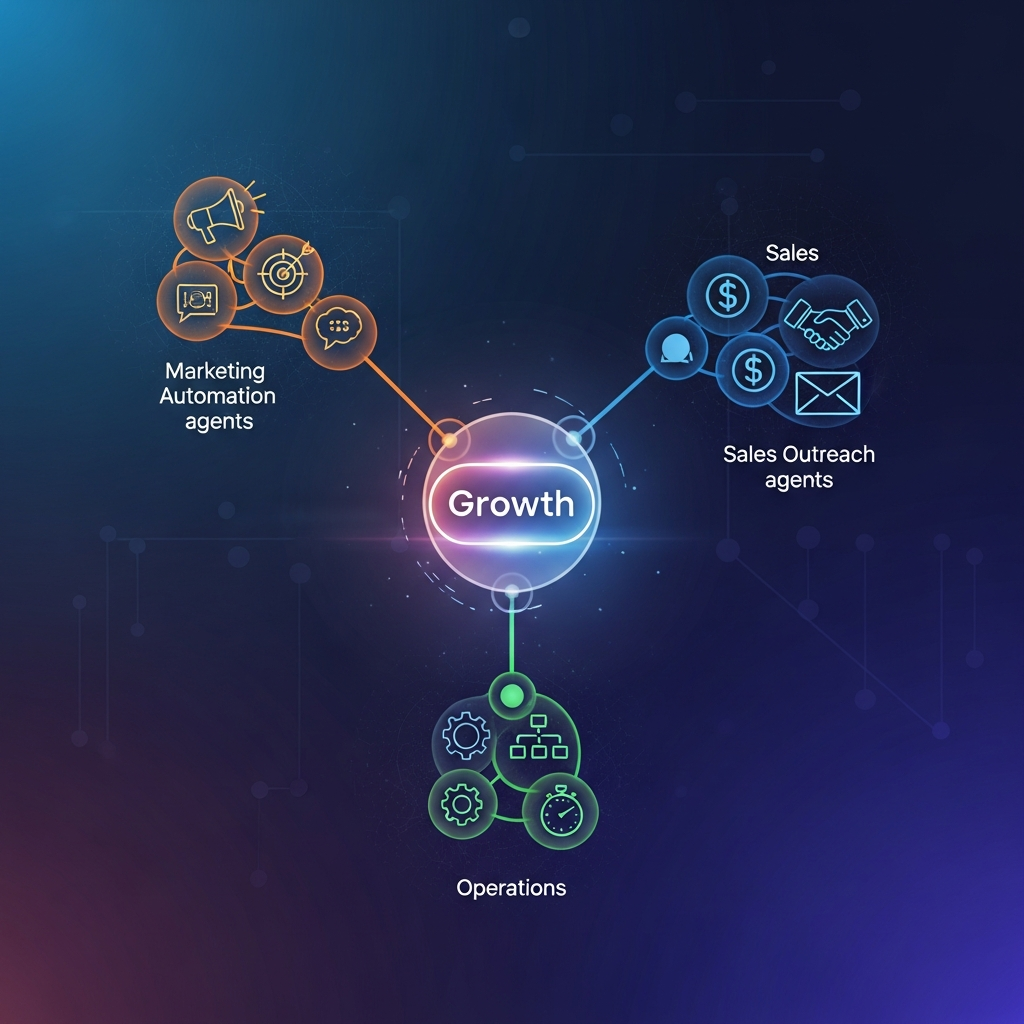
Autonomous Agents in Growth: Concrete Marketing, Sales and Operations Use Cases
What are autonomous agents?
Autonomous agents are software entities that can observe a problem space, reason about goals, make decisions, and act without requiring minute-by-minute human guidance. They combine large language models, structured data processing, and rules-based systems to operate across apps, tools, and data stores. They can monitor signals, fetch contextual information, run experiments, and adjust actions in real time. In growth contexts, autonomous agents sit between humans and systems—augmenting decision makers rather than replacing them.
Key capabilities include goal-oriented planning, multi-step task execution, autonomy in choosing tools, and interaction with external services through APIs. They excel at handling routine, high-frequency tasks at scale, such as sending tailored messages, coordinating scheduling, enriching data records, or triggering cross-channel campaigns. When designed with guardrails and human-in-the-loop checks, these agents amplify impact while keeping risk in check.
For growth teams, the practical value lies in turning static processes into dynamic, self-optimizing flows. Instead of a series of handoffs—marketing creates a draft, sales follows up, operations collates data—an autonomous agent can manage a loop that continuously tests, learns, and improves outcomes across the funnel.
Why autonomous agents now?
The last few years have seen a convergence of three forces that make autonomous agents a compelling bet for growth leaders:
- Access to powerful AI models and data pipelines that unlock real-time decisioning at human scale.
- The need for faster experimentation cycles. Markets move quickly, and teams must test ideas with velocity while maintaining quality and compliance.
- Complex technology stacks require orchestration across marketing, sales, and operations. An agent-centric approach helps align these silos without increasing headcount dramatically.
When designed responsibly, autonomous agents reduce busywork, enable more precise targeting, and free critical resources to focus on high-leverage initiatives. The result is a measurable uplift in acquisition, activation, retention, and ultimately, revenue growth.
Marketing use cases: marketing automation agents
Marketing teams can deploy autonomous agents to tighten the feedback loop between audience signals, content, and channels. Below are practical use cases that you can test with your existing stack.
1) Lead enrichment and segmentation
Autonomous agents monitor new and existing leads, pull data from CRM records, third-party data providers, and product analytics, then enrich profiles with intent signals and engagement history. The agent dynamically re-segments audiences for campaigns, ensuring messaging aligns with a user’s stage and likelihood to convert.
Example workflow: when a new lead enters the system, the agent fetches firmographic data, recent website activity, and email engagement, then assigns a tier and triggers a personalized nurture sequence. Over time, it updates segments as signals evolve, reducing wasted spend on low-potential prospects.
2) Content creation and distribution
Autonomous agents can draft blog outlines, email sequences, social posts, and landing pages aligned with brand guidelines. They curate content calendars, optimize for topics with the highest resonance, and publish across channels with appropriate cadence. The agent tracks engagement and iterates on copy and formats in near real-time.
Tip: feed the agent a style guide and a set of target personas. Pair it with a content performance dashboard so you can measure lift in CTR, engagement time, and conversion rate by channel.
3) Campaign orchestration and optimization
Across paid, owned, and earned channels, autonomous agents orchestrate campaigns by selecting assets, adjusting budgets, and timing messages based on observed performance. They continuously run A/B tests, compare creative variants, and reallocate budget toward higher-performing combinations in near real-time.
Approach: start with a single multi-channel campaign, define success metrics (e.g., cost per lead, conversion rate, revenue per visitor), and let the agent optimize within safe guardrails to avoid overspending or quality issues.
Sales use cases: sales outreach agents
Sales teams can scale personalized outreach while maintaining human oversight. Here are pragmatic applications that complement a growing sales motion.
1) Outreach cadences and personalization
Autonomous sales outreach agents craft personalized messages using CRM context, account history, and recent product updates. They tailor tone, value propositions, and calls-to-action for each contact, then deploy messages across email, LinkedIn, and other channels with adaptive cadences.
Guidance: define guardrails for frequency, escalation paths, and compliance (e.g., opt-outs and cadence limits). The agent learns which messages perform best by persona, company size, and industry, then refines future outreach accordingly.
2) Scheduling and meeting generation
One friction point in outbound programs is finding a time that works for busy executives. An autonomous agent can propose slots, check calendar availability, handle rescheduling, and even book follow-up meetings when necessary. This reduces back-and-forth and accelerates the pipeline.
Practical tip: integrate with calendar APIs and set clear policies for time zones and working hours. Provide a simple override path for humans when a meeting requires senior sponsorship.
3) CRM hygiene and forecasting
Over time, data quality degrades. An outreach agent can regularly verify contact details, update engagement histories, and flag stale leads for cleanup. It can also surface insights that feed into forecast accuracy, such as which accounts show rising intent signals or which sales motions yield the best close rates.
This proactive maintenance keeps your CRM trustworthy and helps sales leadership maintain realistic forecast expectations.
Operations use cases: ops automation agents
Operations teams can lean on agents to standardize, automate, and accelerate routine workflows while preserving governance and visibility across processes.
1) Workflow automation and data ops
Autonomous agents orchestrate data pipelines, enforce data quality checks, and trigger downstream tasks when data quality thresholds are met or breached. They can also coordinate cross-functional workflows, such as product analytics handoffs to marketing dashboards or finance reporting.
Key outcome: fewer manual handoffs, reduced data latency, and more reliable dashboards for decision-makers.
2) Customer support automation
Agents can triage inquiries, surface relevant knowledge base articles, and route complex issues to human agents. They can also monitor ticket backlogs, enforce response-time SLAs, and generate suggested replies to accelerate agent productivity without compromising quality.
Best practice: combine the agent with a knowledge graph that curates context from product usage, support history, and customer segments.
3) Analytics and reporting automation
Automated reporting agents collect metrics from diverse data sources, generate executive-ready dashboards, and flag anomalies or trends that require review. They can also schedule periodic reports and redistribute insights to stakeholders based on relevance and cadence.
Benefit: leadership receives timely, accurate intelligence without manual data wrangling.
Architecture patterns and best practices
Designing autonomous agents for growth requires thoughtful architecture and governance. The following patterns help ensure reliability, security, and ROI.
1) API-first, event-driven architecture
Adopt an API-first approach so agents can communicate with CRM, marketing automation, analytics platforms, and data stores through well-defined interfaces. Add event-driven patterns to react to signals in real time, enabling low-latency decisioning and scalable orchestration across systems.
2) Data governance and privacy by design
Define data ownership, retention policies, and access controls. Ensure data processing complies with applicable laws and standards. Build privacy into agent prompts and decisioning logic to minimize risk and protect sensitive information.
3) Observability, guardrails, and human-in-the-loop
Instrument agents with logs, metrics, and dashboards. Establish guardrails to prevent runaway actions, including rate limits, budget caps, and escalation paths. Keep humans in the loop for critical decisions, using confidence scores and review gates when necessary.
4) Security and compliance
Apply threat modeling, encryption at rest and in transit, and regular security testing. For regulated industries, align with standards such as SOC 2, ISO, or sector-specific frameworks. Document audit trails for actions taken by agents to support governance and traceability.
5) Integrations with CRM and marketing stacks
Plan connectors to Salesforce, HubSpot, or other platforms using secure, scalable APIs. Maintain a clear data flow diagram and ensure backward compatibility as systems evolve. This reduces integration risk and accelerates time-to-value for pilots.
A practical 4-week pilot plan
Use the following practical cadence to test autonomous agents with low risk and high learning potential.
- Week 1 — Define a single high-value use case. Map the data sources, stakeholders, and success metrics. Draft guardrails and decide on non-negotiables (trigger events, response times, and escalation rules).
- Week 2 — Select the approach and architecture. Decide whether to buy an agent service, partner with a development team, or build a lightweight prototype. Establish data governance, security checks, and integration points.
- Week 3 — Run a controlled pilot. Deploy a minimum viable agent in a sandboxed environment. Measure performance against the predefined success criteria. Capture learnings and adjust guardrails.
- Week 4 — Measure ROI and decide on scaling. Compare the pilot results to baseline. Prepare a business case for scaling, including resource needs, governance considerations, and a phased rollout plan.
Tip: start with a cross-functional working group that includes marketing, sales, operations, and data science. This helps ensure alignment, data availability, and practical guardrails from day one.
ROI, governance, and metrics
Quantifying the impact of autonomous agents requires a careful approach that links activities to outcomes. Consider a mix of efficiency, velocity, and revenue metrics.
- time saved per task, reductions in manual data entry, fewer escalations.
- Velocity improvements: cycle time from signal to action, days to first value, number of experiments run per week.
- Revenue impact: lift in MQL-to-SQL conversion, improved win rate, faster deal closure.
- Cost reductions: lower cost per outreach, lower human-hour requirements for repetitive tasks.
- Quality and compliance: data accuracy, reduced risk exposure, auditability of agent actions.
Establish a baseline before the pilot, then track the same metrics monthly during and after the pilot. Use a simple ROI calculator that considers both hard savings and the value of faster experimentation and learning.
Common pitfalls and how to avoid them
- Over-automation: Automating too many decisions too early can erode trust. Start with explicit guardrails and a clear human-in-the-loop path.
- Data quality problems: Inaccurate data feeds poison agent decisions. Invest in data governance and validation before you deploy.
- Scope creep and cost risk: Define a narrow pilot and a concrete exit criteria. Expand only after measurable success.
- Privacy and compliance gaps: Map data flows and ensure compliance with applicable regulations from the outset.
- Model drift and stale context: Implement monitoring that detects drift and triggers human review when confidence degrades.
Addressing these pitfalls upfront reduces risk and helps you move from a pilot to a sustainable, scalable program.
Getting started: practical next steps
To translate these ideas into action, begin with a well-scoped pilot. Identify a single, high-impact area where data, tooling, and personnel are ready for experimentation. Use guardrails, establish a success metric, and appoint a cross-functional champion to oversee governance.
As you progress, document the decisioning logic, data lineage, and outcomes. Share learnings across teams to build organizational confidence in autonomous agents. When you’re ready to scale, expand to additional use cases and deepen integrations with your CRM, marketing stack, and analytics platforms.
In practice, teams often partner with a capable growth engineering partner to design, implement, and operate the pilot. A partner can help with architecture, data integration, model selection, and rigorous testing, while keeping governance and risk controls in place.