
API Contracts Orchestration Playbook
- all
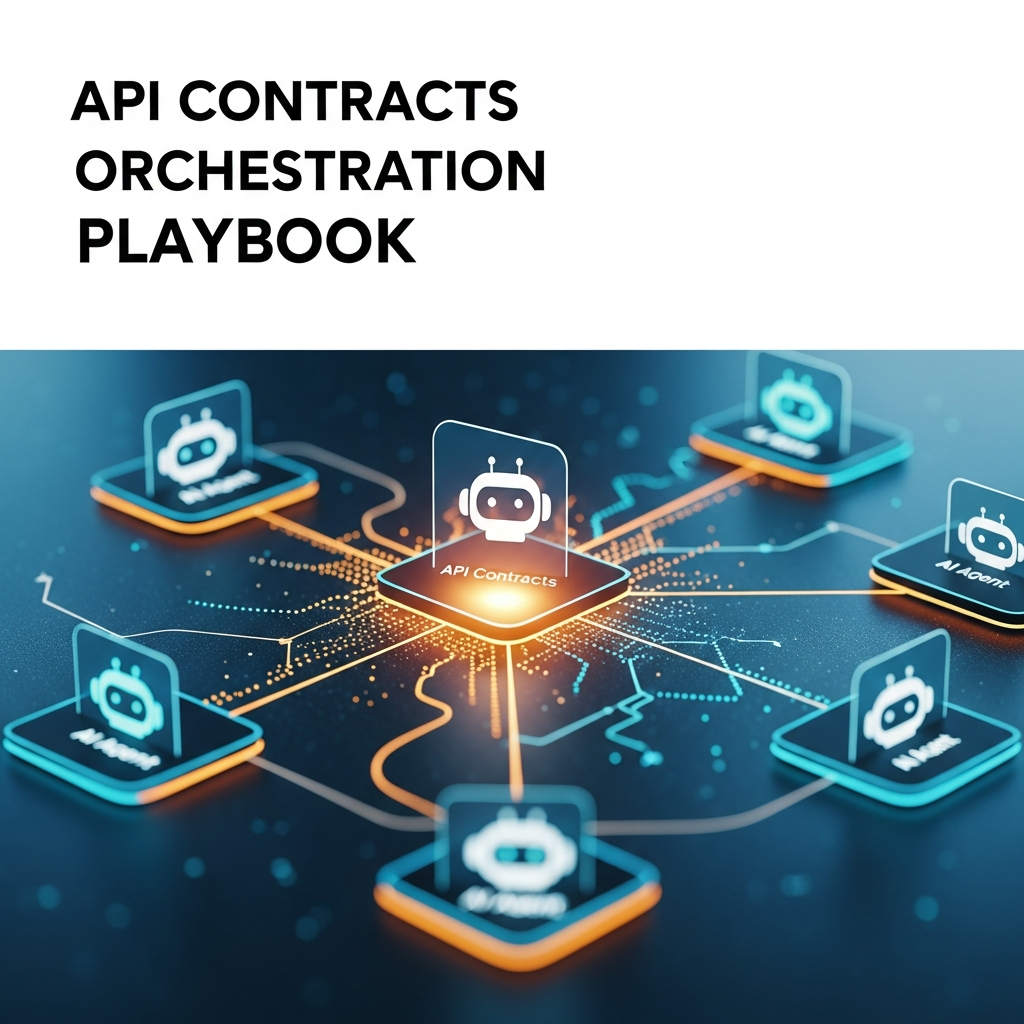
API Contracts Orchestration Playbook
Why API contracts matter for AI agents
In multi-agent ecosystems, the quality of interactions between agents often determines the success of the entire workflow. API contracts formalize expectations: what data is exchanged, in what format, under which conditions, and with which guarantees. For AI agents, contracts become a control plane that aligns capabilities, prompts, and responses with business objectives.
Without clear contracts, integrations drift over time. AI agents may misinterpret inputs, return inconsistent outputs, or violate latency and privacy constraints. A robust contract layer provides: predictability, auditability, and the ability to test and reason about interactions before they hit production. This is especially critical in regulated environments and when orchestrating dozens of microservices across distributed teams.
Key benefits include faster onboarding of new agents, safer experimentation with model updates, and a governance model that scales as your AI stack grows. In practice, contracts act as the single source of truth for interfaces, semantics, and performance expectations across the entire agent network.
Anatomy of an API contract for AI agents
An API contract for AI agents extends traditional interface definitions with constructs tailored to artificial intelligence and distributed orchestration. Here is a practical blueprint you can adapt.
Interfaces and data schemas
Interfaces define the shapes of requests and responses, including required fields, optional fields, and data formats. Data schemas should be explicit about data types, nullability, and field-level semantics. For AI agents, consider including provenance metadata, confidence scores, and versioned data contracts to track how inputs and outputs evolve over time.
Semantics and capabilities
Semantics describe the meaning and intent behind each interaction. This includes observable behaviors, success criteria, and failure modes. Capability-based contracts help ensure agents expose only the functions they are authorized to perform, reducing surface area for errors and misuse.
Versioning and backward compatibility
Contracts must evolve without breaking existing workflows. Use semantic versioning and deprecation timelines. Maintain a contract registry where consumers can pin to protected versions while gradual rollouts occur for newer ones.
Security and privacy constraints
Contracts should articulate authentication methods (mTLS, OAuth), authorization boundaries, data minimization rules, and data handling policies. For health, finance, or personal data, embed compliance requirements directly into the contract to guide implementation and auditing.
Performance and reliability
Define latency targets, throughput, and retry semantics. Specify idempotency guarantees and timeouts. For AI workflows, also describe expected model warm-up times and caching rules to maintain predictable performance.
Error handling and observability
Contracts must describe error formats, codes, and remediation steps. Include observability hooks such as tracing IDs, structured logs, and metrics that teams can monitor to detect anomalies quickly.
Designing API-first agent integration
API-first design begins with contract definitions, not code. Start with a contract-centric mindset to ensure agents can be composed into larger workflows with minimal friction.
Contract templates and artefacts
Use OpenAPI/Swagger as the primary interface specification for requests and responses. Augment with a Contract Canvas that captures purpose, actors, interfaces, semantics, data, timing, errors, security, and governance. Maintain human-readable documentation alongside machine-readable specs.
Consumer-driven contracts for AI agents
Leverage consumer-driven contract testing where downstream consumers (agents relying on others) publish expectations that upstream producers must satisfy. This reduces integration risk as API contracts evolve.
Test harnesses and automated validation
Invest in automated contract tests that run in CI/CD pipelines. Include semantic checks (meaning of data), schema validation, and integration tests that simulate realistic AI prompts and responses. Treat test data as a first-class artefact, with synthetic datasets that mimic production input shapes.
Orchestration patterns for multi-agent workflows
Choosing the right orchestration pattern affects observability, fault tolerance, and performance. Here are common approaches tailored for AI agent networks.
Central orchestrator vs federated orchestration
A central orchestrator provides a single control plane, excellent for global policy enforcement and end-to-end tracing. Federated orchestration distributes control across agents, improving resilience and reducing coupling. A hybrid approach often yields the best balance: a central policy layer with local orchestration at the agent level.
Event-driven versus request-driven
Event-driven architectures excel at asynchronous AI workflows, enabling agents to react to events in near real-time. Request-driven patterns suit synchronous tasks where responses are required promptly to proceed with the next step. Combine both with well-defined event schemas and correlation IDs.
Synchronous vs asynchronous contracts
Synchronous calls are simple to reason about but can introduce latency bottlenecks. Asynchronous flows improve throughput and fault tolerance but require robust correlation, idempotency, and eventual consistency considerations. Contracts should clarify when to use each mode and how to handle transitions between modes safely.
Contract testing and governance
Governance ensures contracts remain trustworthy as teams and AI models evolve. Establish clear ownership, version control, and review processes for every contract change.
Contract testing framework
Adopt a layered testing approach: contract tests (schema and semantics), integration tests (end-to-end agent interactions), and consumer-driven tests (downstream expectations). Use synthetic data and simulated AI prompts to validate behavior under edge cases.
Versioning strategy
Maintain a registry of contract versions with explicit deprecation windows. Publish migration guides and provide a sunset plan to minimize disruption for dependent workflows.
Governance model
Assign a contract ownership matrix, ensure change approvals by product and security teams, and document compliance constraints. Regularly audit contract quality, test coverage, and runtime adherence to SLAs.
Security, privacy, and compliance considerations
AI-driven contracts introduce unique regulatory and security challenges. Treat data minimization, consent, and auditable access as core contract attributes.
Authentication and authorization
Enforce strong identity management and token-based access. Use mutual TLS where appropriate and restrict privileges to the minimum necessary for each agent.
Data handling and retention
Specify data retention windows, encryption at rest and in transit, and procedures for data erasure. For sensitive domains, embed HIPAA, FERPA, or equivalent controls into the contract as a design requirement.
Auditability and traceability
Maintain immutable audit logs for decision points, prompts, and agent responses. Include trace identifiers to diagnose issues without exposing sensitive data.
Operational considerations: observability and reliability
Contracts are only useful if you can observe and verify them in production. Build instrumentation into contracts and the orchestration layer to detect drift, latency spikes, and failed interactions early.
Monitoring and metrics
Track contract-level metrics such as schema validity, latency per interaction, success rates, and time-to-resolution for failures. Use a standardized set of tags to enable cross-workflow dashboards.
Retry, backoff, and fault handling
Document retry policies, exponential backoffs, and idempotent behavior. Design fallback strategies for degraded AI performance to avoid cascading failures across the network.
Observability tooling
Leverage tracing (e.g., distributed traces with correlation IDs) and structured logging to root-cause contract issues quickly. Integrate with existing observability platforms to keep operational overhead low.
A practical step-by-step playbook
: Map the business objective, list all participating agents, and outline the decision points where contracts are consulted. : Create an interface spec, data contract, semantics, security constraints, and governance rules. Publish them in a centralized registry. - Choose orchestration patterns: Decide on central vs federated control, event-driven vs request-driven flows, and synchronous vs asynchronous modes.
- Prototype with safe data: Build a sandbox or staging environment with synthetic data to validate prompts, data shapes, and contract compliance.
- Implement contract tests: Establish a layered test suite that covers schema validation, semantics, and end-to-end interactions among agents.
- Governance and versioning: Set ownership, review cadences, and provide a deprecation plan for evolving contracts.
- Deploy with observability: Enable tracing, metrics, and alerts tied to contract health and agent performance.
- Iterate and evolve: Use feedback loops from production runs to refine contracts, update documentation, and adjust governance policies.
Common pitfalls and anti-patterns
- Overly rigid contracts that stifle experimentation with AI agents.
- Unclear ownership leading to drift between teams and agents.
- Ignoring data privacy requirements in early contract design.
- Assuming AI models will always produce deterministic results.
- Delaying contract testing in favor of rapid prototyping.
Mitigate these by favoring versioned, test-driven contracts that evolve with clear governance. Regularly rehearse failure scenarios and establish safe fallbacks to prevent cascading issues in production.
Tools, frameworks, and best practices
Adopt a pragmatic toolkit for contract design, testing, and governance. Practical options include:
- OpenAPI for interface definitions and Swagger UI for documentation.
- API contract testing frameworks and consumer-driven testing approaches.
- Contract registries and versioned artefacts to manage evolution.
- Security standards and threat modeling as part of contract design.
In practice, pair API-first design with robust runtime governance: automated checks during CI/CD, policy-as-code for security, and a clear change-management process for contract updates.
Conclusion and next steps
API contract orchestration for AI agents is not a niche capability—it is a core requirement for scalable, trustworthy multi-agent systems. By defining precise interfaces, semantics, and governance, product and engineering teams can reduce risk, accelerate delivery, and unlock more ambitious AI-driven business outcomes.
Start small with a contract blueprint, implement a lightweight orchestration layer, and iterate with real production data. As your AI ecosystem grows, the contract layer will become the backbone of reliable, auditable, and secure agent interactions that drive measurable value.
For more practical guidance aligned with enterprise-grade delivery, explore our broader capabilities around microservice contracts and API-first agent integration as you scale your AI-enabled workflows.